
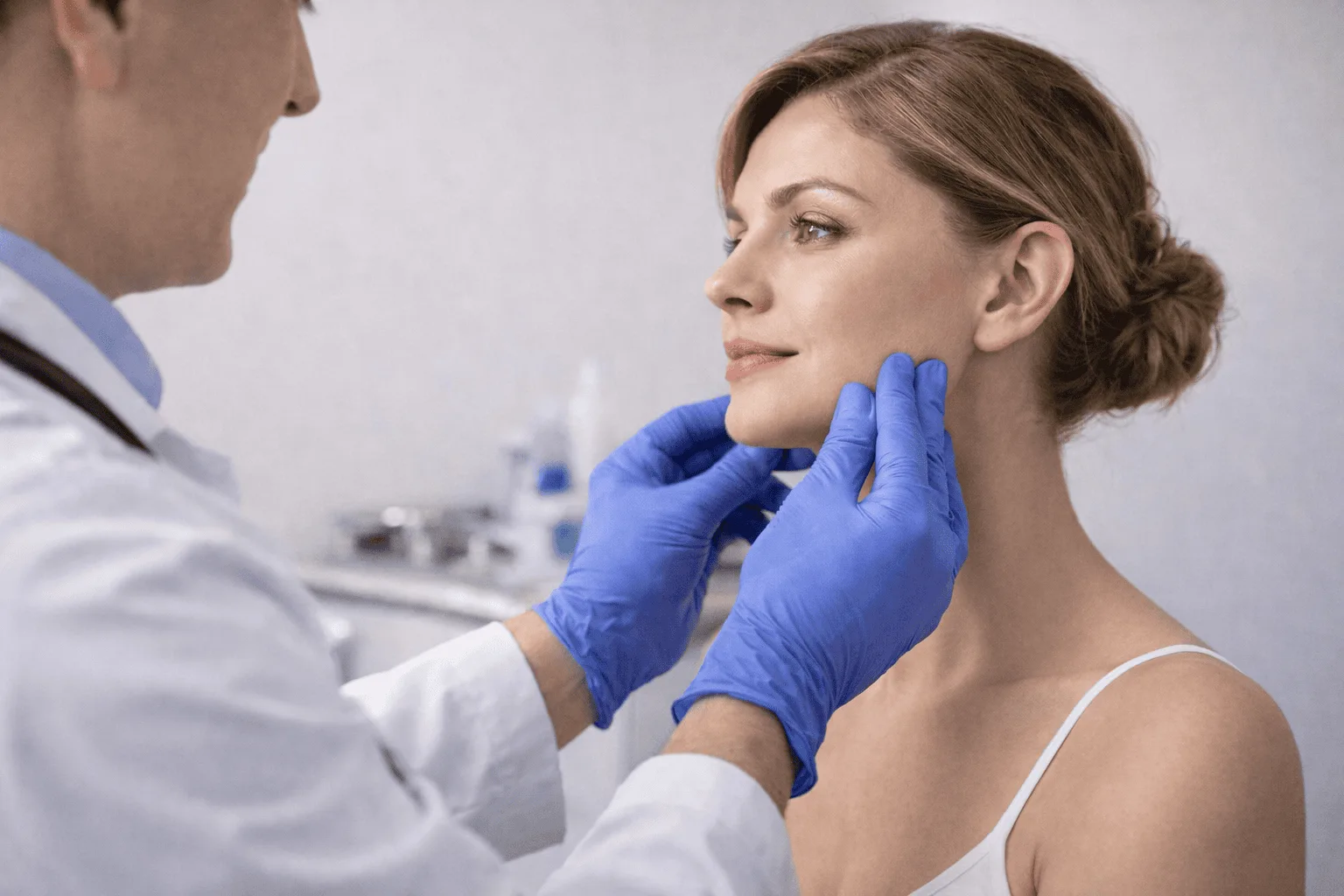
Masseter botox temporarily relaxes the chewing muscle that becomes overworked through excessive teeth grinding. It aims to ease tension symptoms in the jaw and temples, and to reduce the width that a thickened muscle gives the lower face. At my clinic in Nişantaşı, Istanbul, I assess this treatment from both angles — the functional complaint and the facial contour.
Waking with a tired jaw, persistent tension in the temples through the day, or a constant stiffness in the neck is not a coincidence. Behind these pictures there is often teeth grinding done without awareness.
What the masseter does, and where the problem starts
The masseter closes your jaw and is one of the strongest muscles in the body. Its normal function is chewing. But with stress, sleep quality and certain bite problems, the muscle can stay contracted through the day or during sleep.
This constant contraction has two separate consequences. The first is functional: the muscle tires, load on the jaw joint increases, and tension can spread to the temple and neck muscles. The second is structural: like any muscle in constant use, the masseter thickens over time and the lower face looks wider and more square.
A jaw does not always look wide because of volume, either. Where the width comes from the chewing muscle, filler is not the right tool: masseter botox reduces muscle volume and slims the lower face, while filler adds volume and defines the line. They work in opposite directions, and which one is needed is decided at the consultation.
Botox temporarily reduces the muscle’s contraction force and addresses both. Chewing function is not removed; only the excess force is limited.
My approach: we discuss the cause first
I do not see treating teeth grinding as simply injecting a muscle. The muscle is carrying out an instruction from the nervous system; treatment applied without discussing why that instruction is being given returns to the same point once it wears off.
At the examination we look together at your sleep pattern and quality, your stress load during the day, caffeine intake, deficiencies related to muscle function — magnesium in particular — and any bite problems identified by your dentist. Botox is the tool within this picture that eases the symptom quickly; lasting relief also needs the underlying cause addressed.
With the habit that comes from anaesthesiology and pain management, I assess a complaint in the jaw not in isolation but together with the muscle chain of the head and neck. Where appropriate I include complementary approaches such as acupuncture and neural therapy in the plan.
Not one muscle, but a group
The masseter is not the only muscle working during teeth grinding.2, 3 The temporalis muscle at the temple takes part in the same movement and strengthens in people with a persistent clenching habit. I assess both muscles by hand at the examination; if there is marked strengthening in the temporalis, I do not limit the treatment to the masseter alone.
In my practice I observe that planning the two muscles together gives noticeably stronger relief. The reason is that clenching force belongs to a group rather than a single muscle: when only the masseter is relaxed, the load can shift to the other. Relief in temple tension, and in the neck and shoulder complaints that accompany it, is generally clearer with this combined planning.
The procedure
At the examination I ask you to clench so I can assess the muscle’s borders and strength by hand. A difference in thickness between the two sides is common, in which case the dose differs on each side.
After numbing cream is applied for comfort, the treatment is given with fine needles to the most active part of the muscle. It takes around 10 to 15 minutes.
The effect appears at two different speeds. Relief in tension and fatigue is usually felt within the first week. Slimming along the jawline depends on the muscle’s volume reducing, so it becomes noticeable after 3 to 4 weeks. Duration averages 4 to 6 months. I recommend leaving at least 3 months before repeating.
Visiting Istanbul or living here?
A large part of my patients are people living in Istanbul as foreign residents or visiting the city, so the practical questions come up often.
Same-day, no stay required. This is a walk-in treatment. There is no recovery period and you do not need to extend your trip for it.
Flying is not a problem. Cabin pressure does not affect the result. You can travel the same day.
Aftercare
For the best result, a few simple points on the first day are enough:
- Stay upright for the first 4 hours. Do not lie face down or keep your head bent forward.
- Do not massage or rub the treated area.
- Avoid very hot showers for 24 hours, and saunas and steam rooms for the first week.
- Avoid heavy exercise and intense cardio for the first week.
- Avoid alcohol on the day of treatment.
For this area specifically: in the first week you may feel slight fatigue when chewing very tough foods such as hard nuts or steak. This is a temporary adjustment period.
Mild redness or a small bruise may appear at the injection points and settles within a few days. Allergic reactions are rare, which is why treatments are carried out under medical supervision.
What we review together at your consultation
-
Pregnancy and breastfeeding
-
An active skin infection at the treatment site
-
Neuromuscular junction disorders
-
Known hypersensitivity to botulinum toxin components
-
Your current medication and general health
-
A diagnosed jaw joint problem or ongoing dental treatment
If any of these applies to you, we plan a more suitable alternative rather than proceeding.
Frequently asked questions
I use a night guard. Do I still need this?
They do different jobs. A night guard protects your teeth from wear but does not stop the clenching movement; you can clench firmly against the guard and still wake with tension. Botox reduces the muscle’s strength and so affects the force of the movement.1, 2 The two can be used together, and that is how most of my patients proceed.
Will it help my neck and shoulder tension?
Excessive tension in the jaw muscles often creates a chain spreading to the temple, the back of the neck and the shoulders. In my practice a significant proportion of patients describe relief not only in the jaw but in the neck and shoulder area, particularly where the masseter and temporalis have been planned together. If your complaint has another cause, that needs assessing separately.
I only had the masseter treated and my temples became more prominent. Why?
Chewing load does not belong to one muscle. When only the masseter is relaxed, clenching force can shift to the temporalis at the temple, and that muscle can become more prominent over time. This is exactly why I assess both muscles at the examination and plan them together where needed.
Will my chewing weaken?
Not to a degree that affects your normal eating. Other muscles take part in chewing, and the treatment limits only the excess force. You may feel slight fatigue with tough foods in the first week; it passes.
Will my smile change?
The masseter is a separate muscle from those that produce your smile, and in a correctly planned treatment your smile is not affected. What matters here is which part of the muscle is injected: approaching too closely to the upper-front border of the masseter makes it possible to affect the neighbouring smile muscles. This is why I ask you to clench at the examination, establish the muscle’s borders by hand, and treat within those borders at a safe distance. Following the aftercare — particularly not massaging the area — also helps keep the product where it was placed.
Will my face sag?
Not expected with appropriate patient selection. In people whose skin elasticity has reduced, skin support can decrease as muscle volume reduces; if I anticipate that at the examination, I add treatments supporting skin quality to the plan or adjust the dose accordingly.
How much will my face slim?
Entirely dependent on how much your muscle has thickened. Where thickening is marked the difference is clear; where the muscle is of normal thickness, no visible change should be expected. When I assess the muscle by hand at the examination, I tell you plainly.
Can I have it purely for slimming?
If you have no teeth-grinding symptoms but the muscle is markedly thick, treatment can be considered. If your muscle is of normal thickness I do not recommend it — there is no case for unnecessarily weakening a functioning muscle for appearance alone.
What is the difference between this and chin filler?
They work in opposite directions. Masseter botox reduces muscle volume and slims the lower face; chin filler adds volume and lengthens and defines the jawline. One is not an alternative to the other, and in some patients they are planned together.
Can you tell me the price?
Under the applicable regulations, price information cannot be published on our website. The cost of a treatment depends on the product used, the technique chosen and the extent of the treatment. You can call the clinic for detailed information.
Sources
- Lee SJ, McCall WD, Kim YK, et al. Effect of botulinum toxin injection on nocturnal bruxism: a randomized controlled trial.
- Effect of botulinum toxin A on pain, bite force, and satisfaction of patients with bruxism: A randomized single-blind clinical trial comparing two protocols.
- Efficacy of botulinum toxin type A in the targeted treatment of sleep bruxism: a double-blind, randomised, placebo-controlled, cross-over study.