
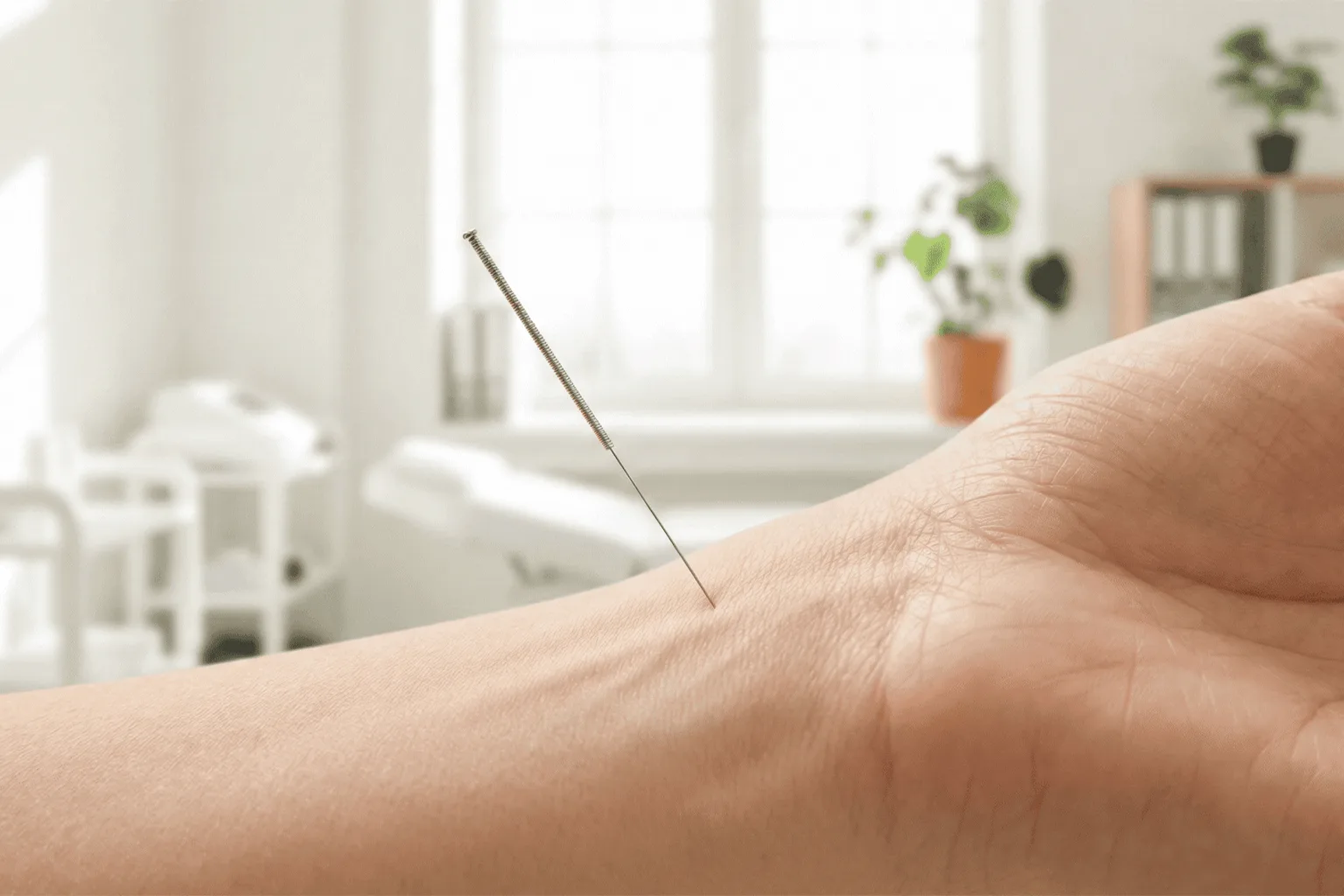
Acupuncture is a drug-free method in which very fine, sterile, single-use needles are placed at specific points on the body to stimulate the nervous system. I use it for chronic low back and neck pain, headache, knee osteoarthritis pain, and for stress and sleep regulation; for weight management, smoking cessation and IVF treatment I plan it as support alongside the relevant treatment, not as a stand-alone solution.
My acupuncture practice certificate was issued by the Turkish Ministry of Health in 2018. In Türkiye, acupuncture is practised by certified physicians under the Regulation on Traditional and Complementary Medicine Practices. The other methods I use for pain are on the pain treatment page.
How is acupuncture explained?
In traditional Chinese medicine the needles are placed at points along lines called “meridians”. Today’s explanation is neuroanatomical: the needle stimulates nerve endings in the skin and muscle, and that stimulus influences pain transmission and pain processing at the level of the spinal cord and brain. The endogenous opioid system and segmental inhibition are two of these explanations; many of the needling points correspond to where nerves pass through muscle and fascia 1.
Honesty about the evidence matters here: in chronic pain, real acupuncture has been found superior both to no acupuncture and to sham acupuncture, but the difference from sham acupuncture is small, and part of the effect is attributed to factors other than needling itself 1. I tell patients this; I do not promise miracles.
The methods I use
Body acupuncture. Applied to points on the arms, legs, back and abdomen. My preference for musculoskeletal pain, headache and general regulation.
Ear acupuncture (auriculotherapy). Needles, needle patches or small seed patches are applied to reflex points on the outer ear; the patches stay in place for a few days up to a week and maintain the stimulus between sessions. I prefer to add it to body acupuncture for stress, appetite regulation and smoking cessation.
When do I use it?
I group indications into three evidence levels, and I tell you at the first consultation which group you are in.
Conditions supported by published studies
- Chronic low back and neck pain 1
- Pain due to knee osteoarthritis 1; the current guideline conditionally recommends acupuncture in knee and hip osteoarthritis 5
- Migraine: as support for preventive treatment; its randomised trials have been assessed in a meta-analysis and it has been reported to reduce attack frequency, with a small effect 2
- Tension-type headache: its randomised trials have been assessed in a meta-analysis; the effect is small 3
For headache with an interventional option, I can plan acupuncture together with or after an occipital nerve block.
Conditions I treat in my clinical practice
- Chronic stress, disturbed sleep and burnout: general regulation sessions aimed at the sympathetic–parasympathetic balance. Many of my acupuncture patients have no pain and come for this alone.
- Fibromyalgia: for pain threshold and regulation, as part of a broader plan; the framework is on the pain treatment page.
Conditions where I use it as support
- Weight management: together with dietitian follow-up. Acupuncture does not burn fat on its own; it supports appetite regulation and stress-related eating.
- Smoking cessation: as support during the quitting process, with ear acupuncture added.
- IVF treatment: to reduce treatment-related anxiety. A randomised trial showed that acupuncture did not increase the live birth rate in IVF 4; I therefore plan it to make the process calmer, not with a promise of pregnancy.
For weight, smoking and IVF I do not offer acupuncture as a stand-alone solution; I plan it together with dietitian follow-up and the relevant treatment.
Acupuncture or neural therapy?
The decision depends on the goal: if drug-free stimulation and general regulation are the priority, acupuncture comes to the fore; if targeting a scar or a specific nerve region with local anaesthetic is the priority, neural therapy does. The final choice is made at consultation.
Neural therapy is introduced as a method in a separate article.
Session plan
- 6–8 sessions, once a week. I use the same protocol for every indication; I do not promise different session counts for different conditions.
- The needles stay in place for 20–30 minutes; a session takes 30–45 minutes in total.
- Ear patches or seeds stay on the ear for a few days up to a week.
- At the end of the course we assess the response together; the decision to continue follows the response, not a calendar.
What a session is like
At the first consultation we go through your complaint, sleep, stress and current treatments; the points to be used are chosen accordingly. During the session, lying down or seated, hair-thin needles are placed at the points. Once the needles are in, most patients describe a marked sense of relaxation; some fall asleep during the session. At the end the needles are removed and, if needed, an ear patch is applied.
The procedure and pain management
Because I am an anaesthesiologist, I treat pain management as a separate part of the procedure.
Acupuncture needles are very fine; what you feel is a brief sting or mild pressure. In a person who is sensitive to needles, I choose the number of points and the needle thickness accordingly.
Safety and anatomy
Sterile, single-use needles are used. Over the chest wall, needling is superficial; points are chosen according to anatomical safety depth. Small bruises, mild soreness and, rarely, brief dizziness can occur at needle sites. Because allergic reactions can occur rarely, treatments are carried out under medical supervision.
Who is not suitable
Treatment is not performed, or is postponed, in the following situations:
- Active infection or inflammation in the treatment area
- Autoimmune disease in an active phase
- Pregnancy and breastfeeding
- Known hypersensitivity to the product components
- Uncontrolled chronic illness
- Untreated bleeding disorder or unregulated anticoagulant use
Electroacupuncture is not performed in a person with a pacemaker. Some physicians use acupuncture in pregnancy, for example for nausea; in my own practice I choose not to offer acupuncture during pregnancy.
Without being a medical contraindication, I also consider expectation and treatment to be mismatched in these situations:
- People with a severe fear of needles
- People expecting a lasting result from a single session
- People with undiagnosed pain — a diagnosis comes first
Suitability is determined by consultation in every case.
Aftercare
Same day
- You can return to daily life
- Avoid strenuous exercise and alcohol for the first few hours; drink water
Expected findings A small bruise or mild tenderness at the needle sites may last 1–2 days. If brief dizziness occurs, sit and rest; if it does not pass, contact the clinic.
Additional advice
- Do not wet or scratch the ear patch or seeds; remove them after the period advised
Pricing
Under the applicable regulations, price information cannot be published on our website. The cost of a treatment depends on the product used, the technique chosen and the extent of the treatment. You can call the clinic for detailed information.
Frequently asked questions
I have no pain — can I have acupuncture just for balance and stress?
Yes. I use it for general regulation in chronic stress, disturbed sleep and burnout; most of my acupuncture patients have no pain and come for this alone. The protocol is the same: once a week, 6–8 sessions.
Does acupuncture help with weight loss?
It does not burn fat on its own. It supports appetite regulation and stress-related eating, which is why I plan it together with dietitian follow-up and do not offer it as a stand-alone weight programme.
Does acupuncture help with quitting smoking?
I use it as support during the quitting process, adding ear acupuncture to body acupuncture. The decision to quit and, where needed, medication support are the core of the process; acupuncture sits alongside them.
Why is acupuncture used during IVF?
To reduce treatment-related anxiety. Acupuncture has not been shown to increase the live birth rate in IVF; I plan it to make the process calmer, not with a promise of pregnancy.
What is ear acupuncture?
Needles, needle patches or small seed patches applied to reflex points on the outer ear. The patches stay on for a few days up to a week and maintain the stimulus between sessions; they are added to body acupuncture for stress, appetite regulation and smoking cessation.
Are you certified in acupuncture?
Yes. My acupuncture practice certificate was issued by the Turkish Ministry of Health in 2018; in Türkiye acupuncture is practised by physicians holding this certificate.
Planning your visit
My clinic is in Nişantaşı, Şişli, on the European side of Istanbul, approximately 45 minutes from Istanbul Airport.
For acupuncture I suggest planning a stay of two to three days: arrival, consultation and treatment, and departure. Because this treatment is planned as a course of sessions, it requires more than one visit. The first session takes place in Istanbul, and we plan the schedule of the following sessions together according to your travel arrangements, with remote follow-up in between. Flying is generally appropriate 24 hours after an injectable treatment.
Consultations are conducted in English. Follow-up after you return home is arranged remotely, and I remain reachable for any questions during the period in which the result develops.
Dr. Ömer Fatih Şahin — Specialist in Anaesthesiology and Reanimation Diploma Registration No: 113606 Acupuncture Practice Certificate — Republic of Türkiye Ministry of Health, 24 April 2018
Published: 22 February 2026 · Last updated: 2026-09-21 This content has been medically reviewed by Dr. Ömer Fatih Şahin.
References
- Vickers AJ, Vertosick EA, Lewith G, et al. Acupuncture for chronic pain: update of an individual patient data meta-analysis. J Pain. 2018;19(5):455–474. https://pubmed.ncbi.nlm.nih.gov/29198932/
- Linde K, Allais G, Brinkhaus B, et al. Acupuncture for the prevention of episodic migraine. Cochrane Database Syst Rev. 2016;(6):CD001218. https://pubmed.ncbi.nlm.nih.gov/27351677/
- Linde K, Allais G, Brinkhaus B, et al. Acupuncture for the prevention of tension-type headache. Cochrane Database Syst Rev. 2016;4(4):CD007587. https://pubmed.ncbi.nlm.nih.gov/27092807/
- Smith CA, de Lacey S, Chapman M, et al. Effect of acupuncture vs sham acupuncture on live births among women undergoing in vitro fertilization: a randomized clinical trial. JAMA. 2018;319(19):1990–1998. https://pubmed.ncbi.nlm.nih.gov/29800212/
- American College of Rheumatology. 2026 Update of the American College of Rheumatology Recommendations for the Management of Osteoarthritis of the Knee, Hip, and Hand (guideline summary). 14 September 2026. https://rheumatology.org/osteoarthritis-guideline