
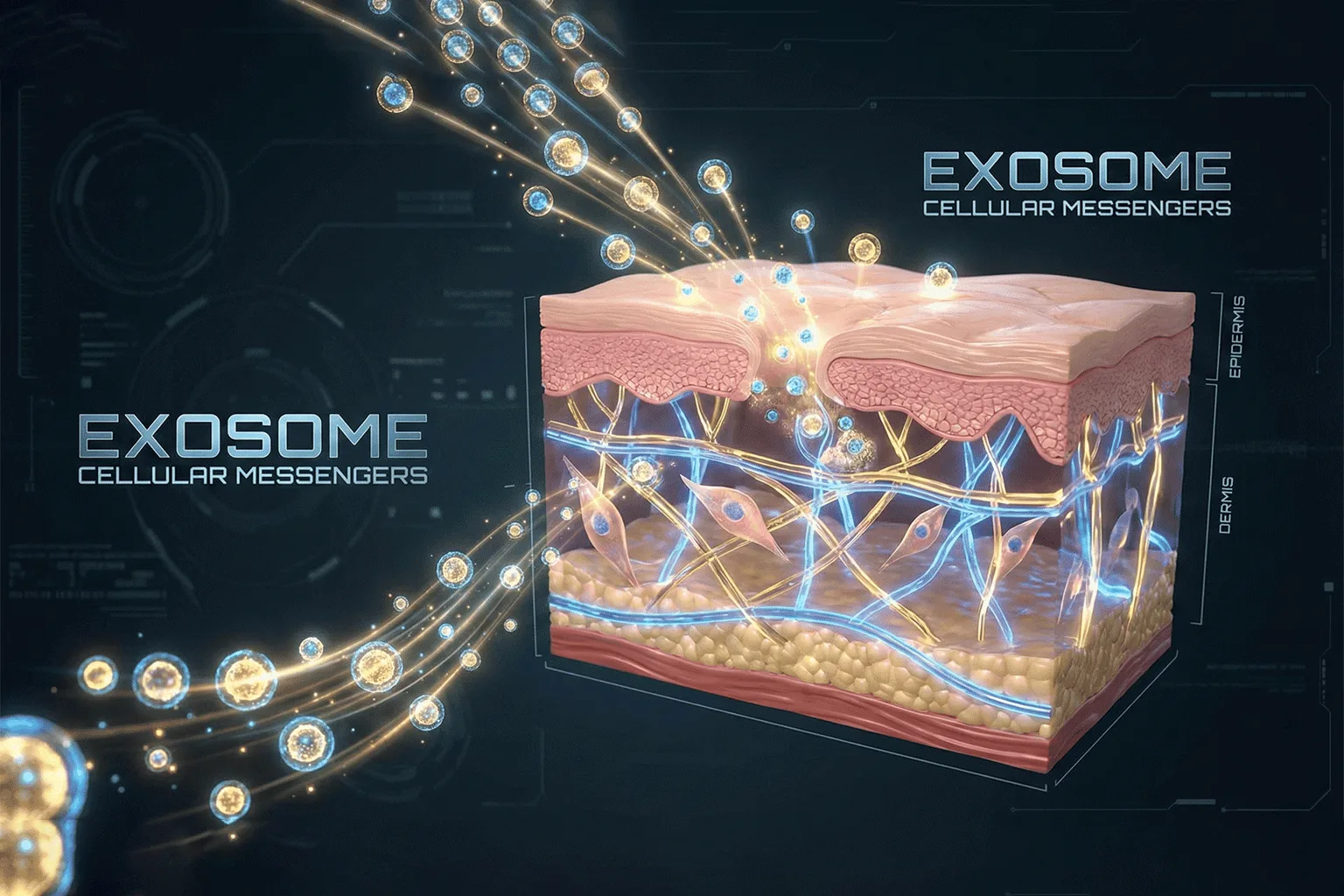
Exosome skin therapy is the application to the skin — by microinjection or after microneedling — of the very small vesicles (extracellular vesicles) that cells release to carry signals to one another. The treatment is cell-free: no living cells are placed into the skin, only the signalling molecules these vesicles carry. It adds no volume; the target is skin quality — loss of elasticity, superficial scars, dullness and redness. The evidence in this field is not yet standardised; I set expectations accordingly and do not present exosomes as a treatment plan on their own.
I am a specialist in anaesthesiology and reanimation; sterile technique and injection safety are core areas of my training. I perform cellular treatments within this framework, carrying out every step of preparation and application myself. The general framework of cellular treatments is on the cellular therapies page.
What are exosomes, and how are they thought to work in the skin?
Exosomes are not stem cells. They are nano-sized vesicles released by cells, containing growth factors, peptides and fragments of RNA. Cells use them to send signals such as “repair” or “reduce inflammation” to one another; this is called paracrine communication.
When applied to the skin, these vesicles are thought to support the function of fibroblasts — the cells that produce collagen and elastin — to modulate the inflammatory response and to contribute to repair of the skin barrier. This mechanism is described in cell and animal studies 2; the human clinical outcome data are set out separately below. Rather than claims such as “instructs the cells what to do” or “achieves cellular renewal”, I use the language of intended effect.
Two sources: human-derived and plant-derived
Human-derived (MSC) exosomes. Purified from the culture medium of mesenchymal stem cells obtained from neonatal umbilical cord tissue. I work with this group for structural goals — loss of elasticity and superficial scars.
Plant-derived vesicles (exosome-like). Obtained by biotechnological methods from plants such as rose and centella. These are not the same molecule as human-derived exosomes, which is why I call them exosome-like vesicles. I consider them for surface goals such as hydration, dullness and redness.
The choice of source depends on the goal: for structural goals such as loss of elasticity and scarring, human-derived exosomes come to the fore; for surface goals such as hydration, dullness and redness, plant-derived vesicles do. The final choice is made at consultation.
I do not rank one above the other; they are tools for different goals.
When do I consider it?
Conditions I assess in my clinical practice:
- General loss of skin quality: dullness, dryness, fine lines and reduced elasticity.
- Superficial scarring and pore appearance: superficial post-acne marks. For deep pitted scars I do not recommend exosomes alone; there, cell-delivering methods such as autologous fibroblasts and combinations are discussed.
- Appearance of pigmentation: as support. Diagnosis and primary treatment of melasma belong to dermatology; I plan exosomes alongside that treatment, not instead of it.
- Sensitive, redness-prone skin: for people who tolerate heat-based treatments poorly.
- Neck, décolletage and the back of the hands: together with the face; region-specific assessment is on the neck and décolletage rejuvenation and hand rejuvenation pages.
How it differs from neighbouring methods
Polynucleotide (salmon DNA) and hyaluronic acid-based mesotherapy products supply building blocks to the tissue; exosomes carry signals between cells. Neither is an alternative to the other; they are products for different goals and can be planned in sequence when needed. Options prepared from your own blood are on the PRP and Sanakin pages.
The intravenous form of exosomes is a separate treatment:
With exosomes, the decision depends on the goal: when surface texture and skin quality are the aim, application to the skin comes to the fore; when general well-being and systemic support are the aim, the intravenous route does. The final choice is made at consultation.
Intravenous application is on the exosome IV page.
Process and session plan
The skin is cleansed and topical anaesthetic cream is applied; the exosome serum is delivered into the skin using mesotherapy technique or after microneedling. The application takes 20–30 minutes.
I do not fix the number of sessions or the interval in advance; I decide at consultation according to the condition of the skin, the goal and the response to the first session. The effect is not immediate: hydration and radiance are reported after the first sessions, and changes in skin quality within months. It varies from person to person, and I give no timelines or percentages without a source.
Being honest about the level of evidence
That exosomes carry signals between cells and can modulate inflammation has been described in cell and animal studies 2. In humans, however, studies are small and protocols are not standardised. A systematic review of 39 studies in aesthetic indications reports improvement in wrinkles, elasticity, skin texture and redness; however, the studies cover different products derived from platelets, plants, animal sources and stem cells, the results are heterogeneous and the protocols non-standardised 1. Another systematic review reports the need for larger, standardised studies with longer follow-up 2. A review of registered clinical trials, most of them outside dermatology, reports a lack of standards in product definition, dosing and reporting 3. Reference 1 was published in a journal supplement sponsored by an exosome manufacturer. Alongside studies reporting improvement there are studies reporting limited benefit and studies without a control group; this is why I give no percentages and apply exosomes as part of an overall plan, discussing expectations openly.
The procedure and pain management
Topical anaesthetic cream is standard. Because I am an anaesthesiologist, I treat pain management as a separate part of the procedure.
Cooling is added when needed; what you feel is a brief sting and mild burning.
Aftercare
First 24 hours
- No make-up on the treated area
- No hot showers, sauna, hammam or steam
- Avoid heavy exercise
- No alcohol
- Do not sleep face-down (facial treatments)
- Do not touch the injection points; do not squeeze or massage the bumps
First 48 hours
- Avoid direct and prolonged sun exposure
- No facial massage, skincare treatments or energy-based device treatments
Expected findings Small bumps (papules) at the injection points lasting 12–24 hours are expected and show that the product has settled in the skin. Mild swelling, tenderness or bruising lasting a few days may occur. Around the eyes, bruising is slightly more likely than on the rest of the face.
Additional advice
- If redness increases, or warmth or fever develops, contact the clinic
Safety and anatomy
Because allergic reactions can occur rarely, treatments are carried out under medical supervision.
The product is cell-free; because no living cells are given, tissue matching is not required. Temporary redness, small bumps and bruising may occur at the injection points; the expected durations are given in the aftercare section. Treatment is postponed if there is an active infection in the area.
Product documentation: I obtain the exosome products I use from accredited laboratories that hold a cGMP production permit approved by the Turkish Medicines and Medical Devices Agency (TİTCK) of the Ministry of Health. The laboratories’ operating status can be checked on TİTCK’s manufacturer and distributor search page. Every product I work with comes with its own certificate showing the production process and the analysis results. Products are transported in the cold chain and used once opened. I do not work with a product that has no documentation. Brand and manufacturer names are not the subject of this page; we discuss which product is used at consultation.
Who is not suitable
Treatment is not performed, or is postponed, in the following situations:
- Active infection or inflammation in the treatment area
- Autoimmune disease in an active phase
- Pregnancy and breastfeeding
- Known hypersensitivity to the product components
- Uncontrolled chronic illness
- Untreated bleeding disorder or unregulated anticoagulant use
I do not perform these treatments during active cancer treatment. For a person with a history of cancer, I make the decision together with the treating specialist.
Treatment is postponed during an active cold sore (herpes) outbreak in the area, during an active acne flare, and if aggressive peeling or laser was performed on the same area within the past two weeks.
Without being a medical contraindication, I also consider expectation and treatment to be mismatched in these situations:
- People expecting a marked change from a single session
- People whose actual need is a change in volume or shape — exosomes do not add volume, and filler is assessed
- People expecting a result from exosomes alone in deep pitted scars
Suitability is determined by consultation in every case.
Pricing
Under the applicable regulations, price information cannot be published on our website. The cost of a treatment depends on the product used, the technique chosen and the extent of the treatment. You can call the clinic for detailed information.
Frequently asked questions
Is exosome skin therapy a stem cell transplant?
No. The treatment is cell-free; no living cells are placed into the skin, only the purified signalling molecules that cells release. Tissue matching is therefore not required.
How do exosomes differ from salmon DNA (polynucleotides)?
Polynucleotide and hyaluronic acid products supply building blocks to the tissue; exosomes carry signals between cells. Neither is more advanced than the other; they are products for different goals and can be planned in sequence.
When does exosome skin therapy work?
No immediate effect is expected. Hydration and radiance are reported after the first sessions, and changes in skin quality within months; some people report no marked difference. I give no timelines without a source.
Planning your visit
My clinic is in Nişantaşı, Şişli, on the European side of Istanbul, approximately 45 minutes from Istanbul Airport.
For exosome skin therapy I suggest planning a stay of two to three days: arrival, consultation and treatment, and departure. Because this treatment may be planned as more than one session, it may require more than one visit. The first session takes place in Istanbul, and we plan the schedule of any following sessions together according to your travel arrangements, with remote follow-up in between. Flying is generally appropriate 24 hours after an injectable treatment.
Consultations are conducted in English. Follow-up after you return home is arranged remotely, and I remain reachable for any questions during the period in which the result develops.
Dr. Ömer Fatih Şahin — Specialist in Anaesthesiology and Reanimation Diploma Registration No: 113606
Published: 22 February 2026 · Last updated: 2026-09-21 This content has been medically reviewed by Dr. Ömer Fatih Şahin.
References
- Stack ER, Spongberg C, Braud SC, Stanton WN, Elway M. Clinical Advances in Exosome-Based Therapies for Aesthetic Medicine: A Systematic Review and Meta-analysis of Human Clinical Trials. Aesthet Surg J. 2026;46(Suppl):S13–S25. https://pubmed.ncbi.nlm.nih.gov/41800726/ — Published in a journal supplement sponsored by an exosome manufacturer.
- Alzahrani A, Alghamdi S, Alahmadi M, et al. Exosomes in Skin Rejuvenation: Systematic Review of Anti-Aging Effects and Clinical Applications. Dermatol Pract Concept. 2026;16(1):6462. https://pubmed.ncbi.nlm.nih.gov/41912205/
- Wang Y, Zhu J, Ma Q, et al. Trends in mesenchymal stem cell-derived extracellular vesicles clinical trials 2014–2024: is efficacy optimal in a narrow dose range? Front Med. 2025;12:1625787. https://pubmed.ncbi.nlm.nih.gov/41048938/