
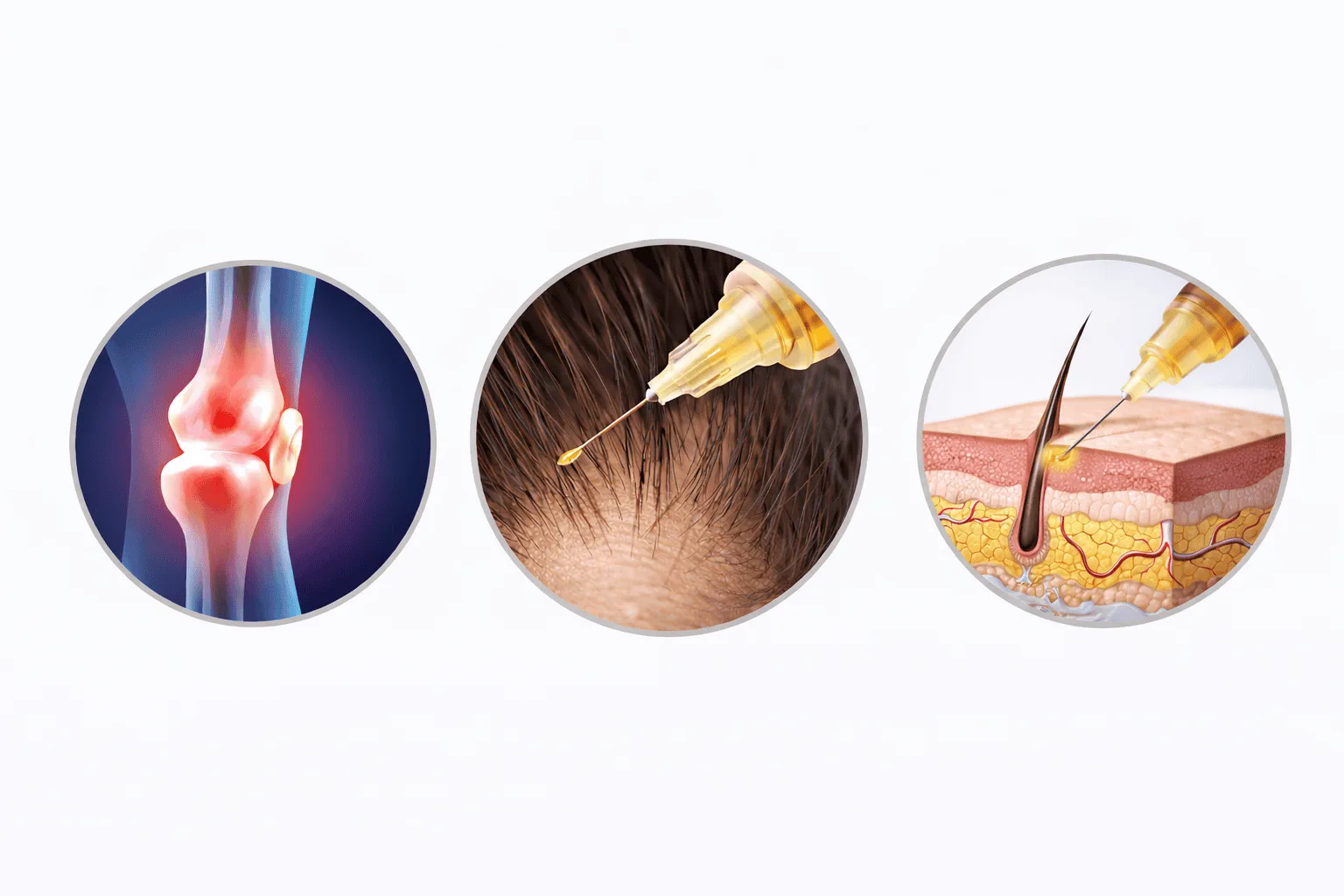
Sanakin is an autologous cytokine-rich serum treatment: your own blood is incubated at body temperature in a special tube so that it becomes enriched in cytokines, and the serum is then injected into the target area. It is popularly known as “smart plasma”. It contains no cells, and no drug or steroid is added. I consider it in skin and scalp conditions where inflammation and redness are in the foreground, and in the knee during the active phase when I want to avoid repeated corticosteroid injections. This page explains how it is prepared, how it is thought to work, how it differs from PRP, and the skin application; the knee application is on the Sanakin for knee osteoarthritis page and the hair application on the Sanakin for hair page.
I am a specialist in anaesthesiology and reanimation; blood sampling, venous access, sterile technique and injection safety are core areas of my training. I perform cellular treatments within this framework, carrying out every step of preparation and application myself. The general framework of cellular treatments is on the cellular therapies page.
How is it prepared?
- Blood draw: about 5 minutes; the blood is collected into the special Sanakin tube, which contains glass beads.
- Preparation: 3 hours. The tube is kept at body temperature; you can leave the clinic during this time.
- Injection: about 10 minutes; the separated serum is injected into the target area.
The serum is prepared solely from your own blood; nothing is added. This is why it is popularly called “natural cortisone” — but it is not cortisone; it is intended to act through the proteins your own blood produces.
How is it thought to work?
According to the manufacturer, when blood cells come into contact with the glass beads in the tube they produce anti-inflammatory proteins, and the serum becomes concentrated in particular in interleukin-1 receptor antagonist (IL-1Ra). IL-1 is one of the important carriers of the inflammatory signal. The serum aims to suppress this signal and then support tissue repair. Human data are not equally strong for every indication; I set this out below.
How does it differ from PRP?
Both are prepared from your own blood, but the content differs: PRP concentrates platelets and growth factors; Sanakin concentrates the cytokines released while the blood is incubated — according to the manufacturer, mainly anti-inflammatory ones. I do not present Sanakin as a rival to PRP; I consider it in skin where redness and inflammation are in the foreground, and in the knee where I want to avoid frequent corticosteroid. PRP has its own page: PRP treatment.
In treatments prepared from your own blood, the decision depends on the goal: when inflammation and redness are in the foreground, the serum enriched in anti-inflammatory proteins comes to the fore; when tissue stimulation and revitalisation are the aim, platelet-rich plasma does. The final choice is made at consultation.
Areas of use
Knee and joints. In knee osteoarthritis, during the active phase when pain and swelling are in the foreground, I consider it in patients for whom I do not want to repeat corticosteroid injections often; for this product class, a randomised trial controlled against placebo and hyaluronic acid reported improvement in pain and function 1. Stage, sessions and comparison with the other options are on the Sanakin for knee osteoarthritis page.
Hair. I consider it in thinning accompanied by scalp itching and inflammation; the session plan and evidence are on the Sanakin for hair page.
Skin. Below.
Skin application
When the goal is skin quality on a background of chronic redness, sensitivity and inflammation, I consider Sanakin. The serum is applied to the skin by microinjection or microneedling.
Conditions I assess in my clinical practice:
- Rosacea and chronic redness: diagnosed by a dermatologist, outside a flare; as support alongside existing treatment.
- Skin quality and superficial scars on a background of inflamed acne: I postpone needle-based application during an active flare; for deep pitted scars I do not recommend Sanakin on its own.
- Fine lines and loss of elasticity in sensitive, reactive skin: as a cell-free, drug-free option for people who tolerate heat-based treatments poorly.
- Around the eyes: with thin skin and redness as the goal, in selected people. If hollowing predominates under the eye, filler is considered; if thin skin and dark circles predominate, biorevitalisers or an under-eye polynucleotide treatment.
For the skin I plan 3 sessions, 2–3 weeks apart. The effect is not immediate; changes in redness and skin quality are reported within weeks and vary from person to person.
Being honest about the level of evidence
The autologous cytokine-rich serum class has a randomised trial in knee osteoarthritis 1; that trial was conducted with a different product of the same class. Reference 1 is affiliated with the manufacturer of the product studied. For skin and hair indications I could not find a controlled human study; here I rely on my clinical practice and write my observation as experience, not as a promise. There is no evidence for statements such as “stops cartilage breakdown” or “cures rosacea”, so I do not make them. The goal is a reduction in inflammation and the resulting improvement in skin quality or pain.
The procedure and pain management
Topical anaesthetic cream is standard. Because I am an anaesthesiologist, I treat pain management as a separate part of the procedure.
Cooling is added when needed; what you feel is a brief sting and mild burning. The blood draw is a standard venous access; what you feel is a brief sting.
Aftercare
First 24 hours
- No make-up on the treated area
- No hot showers, sauna, hammam or steam
- Avoid heavy exercise
- No alcohol
- Do not sleep face-down (facial treatments)
- Do not touch the injection points; do not squeeze or massage the bumps
First 48 hours
- Avoid direct and prolonged sun exposure
- No facial massage, skincare treatments or energy-based device treatments
Expected findings Small bumps (papules) at the injection points lasting 12–24 hours are expected and show that the product has settled in the skin. Mild swelling, tenderness or bruising lasting a few days may occur. Around the eyes, bruising is slightly more likely than on the rest of the face.
Additional advice
- A small bruise on the arm used for the blood draw may last 1–2 days
- If redness increases, or warmth or fever develops, contact the clinic
Safety and anatomy
Because allergic reactions can occur rarely, treatments are carried out under medical supervision.
The serum is prepared from your own blood in a sterile closed system; no drug is added. Temporary redness, small bumps and bruising may occur at the injection points; the expected durations are given in the aftercare section. Treatment is postponed if there is an active infection in the area.
Regulatory status: This product class consists of products assessed under CE and TİTCK frameworks for the relevant indications. The serum or plasma is prepared from your own blood; the kit used is a preparation system within the scope of medical devices. Approval belongs to a product and to a specific indication, not to a technique or to a physician.
Who is not suitable
Treatment is not performed, or is postponed, in the following situations:
- Active infection or inflammation in the treatment area
- Autoimmune disease in an active phase
- Pregnancy and breastfeeding
- Known hypersensitivity to the product components
- Uncontrolled chronic illness
- Untreated bleeding disorder or unregulated anticoagulant use
In treatments prepared from your own blood, treatment is also not performed in haematological disease or during a febrile illness.
Treatment is postponed during an active cold sore (herpes) outbreak in the area, during an active acne flare, and if aggressive peeling or laser was performed on the same area within the past two weeks.
Without being a medical contraindication, I also consider expectation and treatment to be mismatched in these situations:
- People expecting a marked change from a single session
- People whose actual need is a change in volume or shape — Sanakin does not add volume, and filler is assessed
- People with undiagnosed rosacea or acne — a dermatological assessment comes first
Suitability is determined by consultation in every case.
Pricing
Under the applicable regulations, price information cannot be published on our website. The cost of a treatment depends on the product used, the technique chosen and the extent of the treatment. You can call the clinic for detailed information.
Frequently asked questions
Is cortisone or any drug added to Sanakin?
No. The serum is prepared solely from your own blood; nothing is added. It is popularly called “natural cortisone” because it targets inflammation; it is not cortisone.
Is Sanakin suitable for rosacea or sensitive skin?
Once diagnosed and outside a flare, I consider it as support alongside existing treatment. Because it involves no heat and no added drug, it is an option for skin that tolerates heat-based treatments poorly; I make the decision at consultation.
How many Sanakin sessions are needed for the skin?
I plan 3 sessions, 2–3 weeks apart. The effect is not immediate; changes are reported within weeks.
Do I have to wait 3 hours for Sanakin?
After the blood draw you can leave the clinic; when the preparation is finished you return for the application, which takes about 10 minutes.
Planning your visit
My clinic is in Nişantaşı, Şişli, on the European side of Istanbul, approximately 45 minutes from Istanbul Airport.
For Sanakin skin treatment I suggest planning a stay of two to three days: arrival, consultation and treatment, and departure. Because skin treatment with Sanakin is planned as three sessions two to three weeks apart, it requires more than one visit. The first session takes place in Istanbul, and we plan the schedule of the following sessions together according to your travel arrangements, with remote follow-up in between. Flying is generally appropriate 24 hours after an injectable treatment.
Consultations are conducted in English. Follow-up after you return home is arranged remotely, and I remain reachable for any questions during the period in which the result develops.
Dr. Ömer Fatih Şahin — Specialist in Anaesthesiology and Reanimation Diploma Registration No: 113606
Published: 22 February 2026 · Last updated: 2026-09-21 This content has been medically reviewed by Dr. Ömer Fatih Şahin.
References
- Baltzer AWA, Moser C, Jansen SA, Krauspe R. Autologous conditioned serum (Orthokine) is an effective treatment for knee osteoarthritis. Osteoarthritis Cartilage. 2009;17(2):152–160. https://pubmed.ncbi.nlm.nih.gov/18674932/ — Conducted with a different product of the same class. One author received a consulting fee from the manufacturer before the study began; the study is affiliated with the manufacturer.