
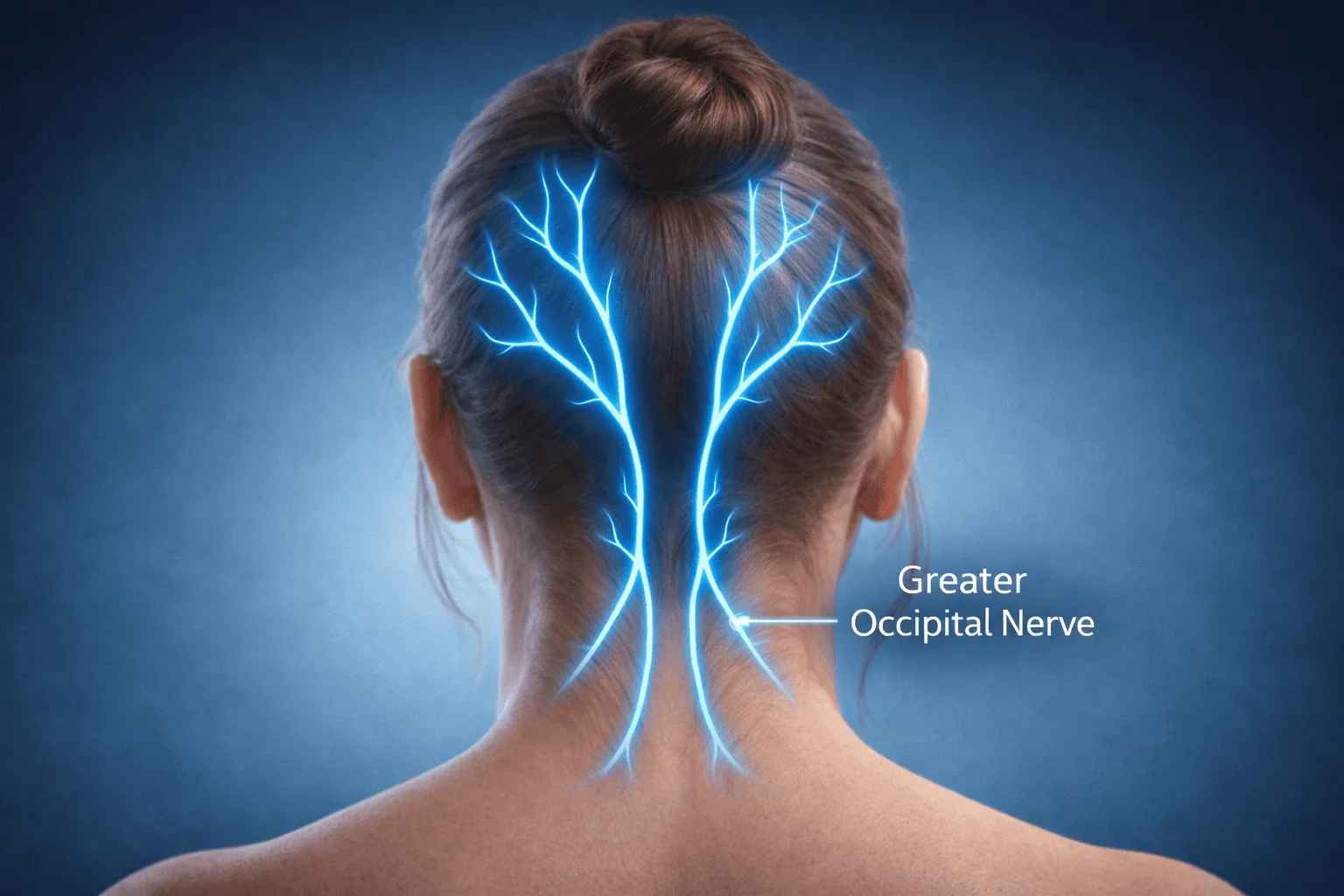
The occipital nerve block is a peripheral nerve block that aims to interrupt, temporarily, the transmission of pain signals spreading from the back of the head to the crown. Local anaesthetic, with corticosteroid added when needed, is placed around the greater occipital nerve (GON) and, where necessary, the lesser occipital nerve (LON). It is considered in chronic migraine, occipital neuralgia and cluster headache, either alongside or as an alternative to medication.
Nerve blocks are part of anaesthesiology training; the pain clinic experience from my specialty training is the basis of this procedure. The general framework of the methods I use for pain is on the pain treatment page; here I describe only this block.
Why the back of the head?
In a proportion of headaches, the pain is related to irritation or sensitisation of the occipital nerves at the back of the head. These nerves emerge from the upper cervical vertebrae, pass through the neck muscles to the scalp and meet the trigeminal system in the brainstem. That meeting point explains why an input arising in the neck can be felt as migraine pain over the forehead and temple; the block targets that point.
When do I use it?
I do not block every headache; I do not plan the procedure without a neurological examination and, where needed, a neurology opinion. Once the diagnosis is clear, I assess it in the following pictures:
- Chronic migraine. In a randomised, multicentre, placebo-controlled trial, weekly greater occipital nerve block was reported to reduce attack frequency and pain severity compared with placebo 1. An independent review of the randomised trials in this field supports a short-term preventive effect, but states that the long-term effect is uncertain and that the trials differ methodologically 2. I assess it in patients whose response to medication is insufficient or who want to reduce their medication use.
- Occipital neuralgia. Lightning-like, stabbing pain starting at the base of the neck. The block both helps with diagnosis and controls the pain.
- Cluster headache. During bouts, as a transitional treatment between attacks; a randomised trial reported that a block with added corticosteroid can shorten this period 3.
- Cervicogenic headache. I assess it in my practice for headache arising from the neck; the evidence here is not as strong as in migraine, and I say so to the patient.
Block or migraine Botox?
In migraine, the decision depends on the goal: when pain control during an attack or in the short term is in the foreground, the occipital nerve block comes to the fore; when long-term prevention in chronic migraine is the goal, migraine Botox does. They can be planned together when needed. The final choice is made at consultation.
Long-term preventive treatment is described on the migraine Botox page. The block can also be used as a bridge while waiting for Botox to take effect.
How is it performed?
- Marking. The point where the greater occipital nerve runs at the base of the neck is identified by palpation using bony and vascular landmarks; the lesser occipital nerve is marked as well if needed.
- Injection. With a fine needle, the medication is placed not into the nerve itself but into the surrounding tissue (the perineural space). Local anaesthetic is used, with corticosteroid added when needed.
- Duration and observation. The procedure takes 5–10 minutes. You are then observed at the clinic for 15–20 minutes, with blood pressure and pulse checked, before returning to daily life.
How often it is repeated depends on the diagnosis and the response; in chronic migraine a series is planned, in cluster headache the bout determines the timing. I set the schedule at consultation and do not publish a general number.
Is corticosteroid added?
When needed, but not at every session. Two randomised trials reported that adding corticosteroid to local anaesthetic gives no additional benefit in chronic migraine; in cluster headache, a block with corticosteroid was found to be effective 23. When corticosteroid is added, hair thinning, skin thinning and lightening of skin colour at the injection site have been reported; for this reason I avoid repeating blocks with corticosteroid and add it when needed, in limited numbers 2.
When does the effect start and how long does it last?
- A reduction in pain from the local anaesthetic usually begins right after the procedure.
- The preventive effect — a reduction in attack frequency — varies from person to person; trials have reported responses lasting weeks, while the long-term effect is uncertain 2.
- Repeat treatment may be needed in chronic conditions.
“A definitive cure” or “a guarantee” are not used in medicine; the aim is to improve quality of life by lowering pain scores and attack frequency.
The procedure and pain management
Topical anaesthetic cream is standard. Because I am an anaesthesiologist, I treat pain management as a separate part of the procedure.
In an injection around the nerve, what you feel is a brief sting followed by numbness in the area.
Aftercare
Same day
- Numbness in the treated area for a few hours is normal; do not drive for the first few hours
- Do not rub the area that day, and avoid strenuous exercise
Expected findings Mild tenderness may last a few days. If redness, warmth or swelling develops at the injection site, contact the clinic.
Safety and anatomy
The injection is placed around the nerve, not into it; that is the safety principle of the procedure. Temporary tenderness, brief dizziness or a vasovagal reaction from a drop in blood pressure can occur afterwards, which is why you are observed at the clinic. Randomised trials have reported no serious adverse events; the adverse effects seen have been mild and transient 2. Because allergic reactions can occur rarely, treatments are carried out under medical supervision.
In a person taking blood thinners, pressure is applied to the injection site for longer and the observation period is extended 2.
Product status: The local anaesthetics and corticosteroids used are licensed medicines for the relevant indications. A nerve block is a technique for administering a medicine; the indication and suitability are determined by medical examination.
Who is not suitable
Treatment is not performed, or is postponed, in the following situations:
- Active infection or inflammation in the treatment area
- Autoimmune disease in an active phase
- Pregnancy and breastfeeding
- Known hypersensitivity to the product components
- Uncontrolled chronic illness
- Untreated bleeding disorder or unregulated anticoagulant use
I do not perform these treatments during active cancer treatment. For a person with a history of cancer, I make the decision together with the treating specialist.
The block is not planned with known hypersensitivity to local anaesthetics, or where there has been surgery or a bone defect in the back of the skull; these two are the recognised absolute contraindications of the method 2. With undiagnosed, new-onset headache, a neurological assessment comes first.
Without being a medical contraindication, I also consider expectation and treatment to be mismatched in these situations:
- People expecting a lasting result from a single treatment
- People with medication overuse headache whose medication has not yet been adjusted — adjustment comes first
- People with undiagnosed, new or changing headache — a diagnosis comes first
Suitability is determined by consultation in every case.
What triggers the pain
While controlling pain with the block, I also assess the posture, sleep and deficiencies that trigger it; the injection is part of that assessment, not all of it. I carry out this assessment at the functional medicine consultation.
Pricing
Under the applicable regulations, price information cannot be published on our website. The cost of a treatment depends on the product used, the technique chosen and the extent of the treatment. You can call the clinic for detailed information.
Frequently asked questions
Is corticosteroid added to the occipital nerve block?
When needed, but not at every session. Randomised trials reported that adding steroid to local anaesthetic gives no additional benefit in chronic migraine; in cluster headache it is added. Because hair thinning, skin thinning or lightening of skin colour can occur at the injection site when steroid is added, I avoid repeating it.
When does the effect of the occipital nerve block start and how long does it last?
Pain usually eases immediately from the local anaesthetic. The preventive effect varies from person to person; trials have reported responses lasting weeks, while the long-term effect is uncertain. Repeat treatment may be needed in chronic conditions.
How often is the occipital nerve block repeated?
It depends on the diagnosis and the response. In chronic migraine a series is planned; in cluster headache the bout determines the timing. The schedule is set at consultation and no general number is given.
Can I drive after an occipital nerve block?
Not for the first few hours; because brief dizziness is possible, you are observed at the clinic for 15–20 minutes after the procedure and it is advised that you do not drive that day.
Planning your visit
My clinic is in Nişantaşı, Şişli, on the European side of Istanbul, approximately 45 minutes from Istanbul Airport.
For an occipital nerve block I suggest planning a stay of two to three days: arrival, consultation and treatment, and departure. Because this treatment may be planned as more than one session, it may require more than one visit. The first session takes place in Istanbul, and we plan the schedule of any following sessions together according to your travel arrangements, with remote follow-up in between. Flying is generally appropriate 24 hours after an injectable treatment.
Consultations are conducted in English. Follow-up after you return home is arranged remotely, and I remain reachable for any questions during the period in which the result develops.
Dr. Ömer Fatih Şahin — Specialist in Anaesthesiology and Reanimation Diploma Registration No: 113606
Published: 22 February 2026 · Last updated: 2026-09-22 This content has been medically reviewed by Dr. Ömer Fatih Şahin.
References
- Inan LE, Inan N, Karadaş Ö, et al. Greater occipital nerve blockade for the treatment of chronic migraine: a randomized, multicenter, double-blind, and placebo-controlled study. Acta Neurol Scand. 2015;132(4):270–277. https://pubmed.ncbi.nlm.nih.gov/25765043/
- Chowdhury D, Mundra A. Role of greater occipital nerve block for preventive treatment of chronic migraine: a critical review. Cephalalgia Reports. 2020;3:1–17. https://doi.org/10.1177/2515816320964401
- Leroux E, Valade D, Taifas I, et al. Suboccipital steroid injections for transitional treatment of patients with more than two cluster headache attacks per day: a randomised, double-blind, placebo-controlled trial. Lancet Neurol. 2011;10(10):891–897. https://pubmed.ncbi.nlm.nih.gov/21903477/