
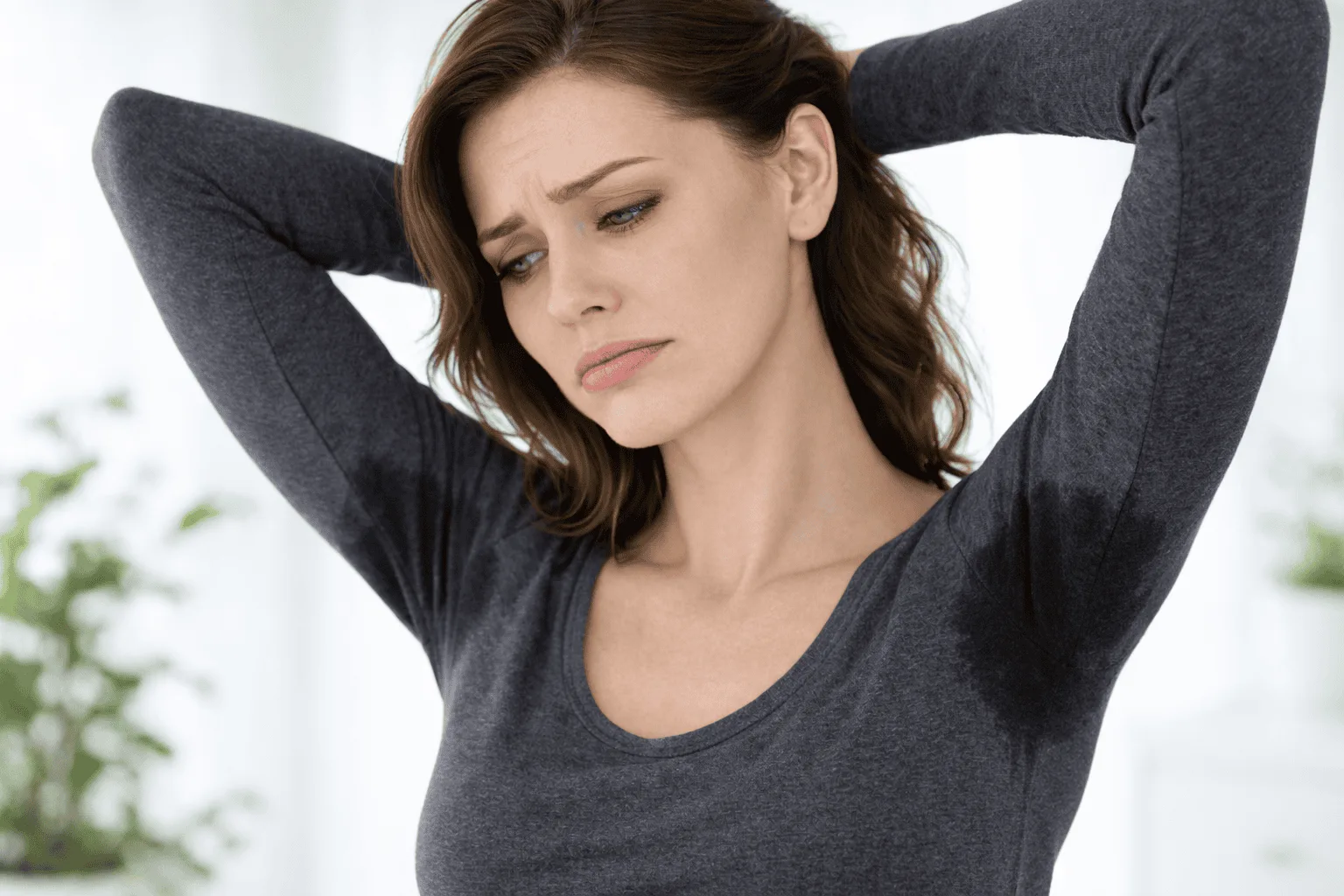
Underarm botox temporarily limits the signal reaching the sweat glands in people with excessive sweating (hyperhidrosis), aiming to bring sweat production down to a normal level.1, 2 It is an FDA-approved treatment for this indication. At my clinic in Nişantaşı, Istanbul, I perform this treatment for the underarm area only. I describe the other uses of botulinum toxin on the botox treatments page; migraine botox, another indication outside aesthetics, has a page of its own.
Excessive sweating is often experienced as a social burden before it is a medical complaint: restricting what you can wear, creating anxiety before a meeting or presentation, requiring a change of clothes during the day. This is not tied to hot weather; in primary hyperhidrosis, sweating continues regardless of season, in winter and in cool environments. That is why the treatment can be planned at any time of year.
How it works
The signal that starts sweating reaches the gland through a messenger molecule called acetylcholine, released from nerve endings. Botulinum toxin temporarily limits that transmission; when the instruction to work does not reach the gland, sweat production in the area reduces.
Because the area stays dry, odour formation caused by bacteria multiplying in a moist environment also reduces. The treatment does not cause lasting damage to the sweat glands or destroy them; it provides a temporary period of rest. When the effect wears off, the glands return to their normal function.
Why the underarm only
I do not perform this treatment for palms and soles at my clinic. The reason is that treatment in the hand can affect grip strength and carries a possibility of limiting daily function. The underarm is both a functionally safe area and the site where the complaint is felt most intensely.
When patients come with palm or sole sweating I tell them this plainly and make an appropriate referral.
The procedure
At the examination I assess the intensity of the sweating, how long it has been present and how it is distributed through the day. Where needed, an iodine-starch test can be used to identify the area of heaviest sweating; this simple test allows the treatment area to be defined more precisely.1
The underarm skin is sensitive, so topical numbing cream is applied beforehand. With the comfort management that comes from anaesthesiology, I pay particular attention to comfort in this area. Small doses are given with very fine needles across the area where the sweat glands are concentrated. The treatment takes around 15 to 20 minutes.
You can return to your day straight afterwards.
How the effect develops
- Onset: a marked reduction in sweating usually begins within 3 to 7 days.
- Full effect: it reaches its peak within 10 to 14 days.
- Duration: 4 to 6 months on average, meaning two treatments a year can keep the complaint continuously under control.
- Repeat: I recommend leaving at least 3 months before repeating. In people who repeat regularly, the effect is often observed to last longer.
Before your appointment
- Trimming the hair in the area 24 hours beforehand is recommended; avoid waxing or anything else that would irritate the skin on the day.
- Do not use deodorant or antiperspirant when you come; the area needs to be clean so the test and treatment area can be defined accurately.
Visiting Istanbul or living here?
A large part of my patients are people living in Istanbul as foreign residents or visiting the city, so the practical questions come up often.
Same-day, no stay required. This is a walk-in treatment. There is no recovery period and you do not need to extend your trip for it.
Flying is not a problem. Cabin pressure does not affect the result. You can travel the same day.
Aftercare
For the best result, a few simple points on the first day are enough:
- Do not massage or rub the treated area.
- Avoid very hot showers for 24 hours, and saunas and steam rooms for the first week.
- Avoid heavy exercise and intense cardio for the first week.
- Avoid alcohol on the day of treatment.
Do not use deodorant or antiperspirant for the first 24 hours.
Mild redness or a small bruise may appear at the injection points and settles within a few days. Allergic reactions are rare, which is why treatments are carried out under medical supervision.
What we review together at your consultation
-
Pregnancy and breastfeeding
-
An active skin infection at the treatment site
-
Neuromuscular junction disorders
-
Known hypersensitivity to botulinum toxin components
-
Your current medication and general health
-
Recent onset of sweating, accompanying night sweats or generalised sweating; the cause should be investigated first
If any of these applies to you, we plan a more suitable alternative rather than proceeding.
Frequently asked questions
If I do not sweat there, can my body still regulate its temperature?
Yes. The underarm makes up a very small proportion of the body’s surface area, and temperature regulation is handled by sweat glands distributed across the whole body. Reducing sweating in this area does not affect your overall heat balance.
Will I not be able to eliminate toxins?
This is a common concern, but the function of sweating is temperature regulation. The elimination of waste products happens largely through the liver and kidneys, and those functions are unaffected.
Will the sweating move somewhere else?
Compensatory sweating in another area to a noticeable degree is not something observed after this treatment. Because there is variation between individuals, we discuss your own observation at the follow-up.
Will my odour problem resolve too?
Odour comes less from the sweat itself than from bacteria multiplying in a moist environment. When the area stays dry, odour formation reduces markedly.
Is there a right season for this treatment?
No. Excessive sweating is not tied to hot weather; in primary hyperhidrosis it continues in winter and in cool environments, and most of my patients describe the complaint increasing in stressful moments regardless of season. The treatment can be planned at any time of year. If you are thinking of a particular event or busy period, allowing around three weeks is comfortable, since the effect settles fully by day 10 to 14.
If deodorants and antiperspirants were enough, would this treatment be needed?
Deodorants largely mask odour, and antiperspirants temporarily narrow the gland opening. In primary hyperhidrosis these are often insufficient. I consider this treatment for people who have not had a result from those steps.
Will the marks on my clothes reduce too?
Because sweat production reduces, patients describe marked relief in staining and discolouration on clothing. It is one of the things my patients mention most often after treatment.
Can you tell me the price?
Under the applicable regulations, price information cannot be published on our website. The cost of a treatment depends on the product used, the technique chosen and the extent of the treatment. You can call the clinic for detailed information.
Sources
- Naumann M, Lowe NJ. Botulinum toxin type A in treatment of bilateral primary axillary hyperhidrosis: randomised, parallel group, double blind, placebo controlled trial. BMJ. 2001;323(7313):596-599.
- Lowe NJ, Glaser DA, Eadie N, et al. Botulinum toxin type A in the treatment of primary axillary hyperhidrosis: a 52-week multicenter double-blind, randomized, placebo-controlled study. J Am Acad Dermatol. 2007;56(4):604-611.