
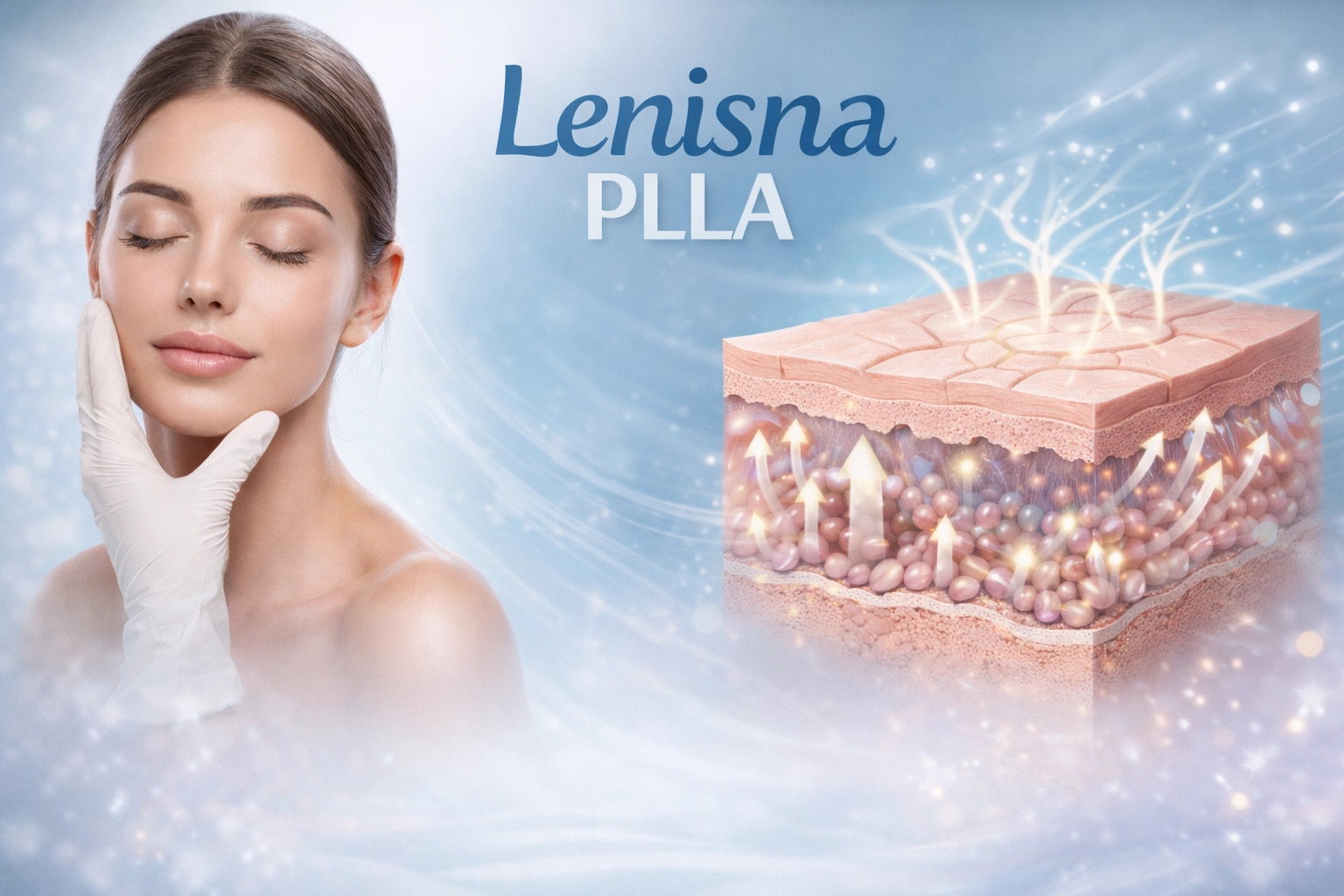
Lenisna is a collagen stimulator containing poly-D,L-lactic acid (PDLLA) and hyaluronic acid. I use this product on the face for skin quality and tissue support.
For the general framework of biostimulator treatments, see the liquid facelift page.
How does Lenisna work?
The active substance in Lenisna is poly-D,L-lactic acid. This polymer is less crystalline than PLLA; the microspheres are round and smooth-surfaced.
Once placed beneath the skin the microspheres stimulate fibroblast cells and initiate new collagen production 1. The lower crystallinity lowers the likelihood of nodules after injection 1. The hyaluronic acid in the formulation extends the duration of the effect 1.
The collagen response becomes noticeable at around week four and reaches its most visible point between the second and third month. The effect lasts on average 18–24 months.
When do I prefer it?
I use Lenisna on the face for skin quality and tissue support:
- General loss of elasticity and thinning of the skin
- Tissue laxity in the cheek area
- Dullness and loss of firmness
I do not use it for shaping. In areas requiring millimetric symmetry such as the jawline, cheekbones and chin, I use hyaluronic acid fillers, which are reversible. This is not a matter of taste but of safety: PDLLA cannot be dissolved with an enzyme. For these areas, see the dermal fillers page.
Where Juvelook comes in
Juvelook, from the same PDLLA class, is also used on the face; what separates the two is the layer in which they are placed.
With PDLLA on the face, the decision depends on the layer of the problem: if scarring, pores and surface roughness dominate, Juvelook, placed within the dermis, comes forward; if deep-layer tissue support and firmness are needed, Lenisna comes forward. The final choice is made at the consultation.
So the question is not which is better, but which layer the problem is in. For scarring and surface concerns, see the Juvelook page.
How the treatment is performed
During consultation I assess skin thickness, the degree of laxity and what the tissue needs.
Topical anaesthetic cream is standard. Because I am an anaesthesiologist, I treat pain management as a separate part of the procedure.
I place the product with a cannula in the correct layer. The treatment takes around 20–30 minutes. You can return to daily life the same day.
Number of sessions: I plan 1–2 sessions depending on the individual. Skin thickness and the degree of laxity are decisive.
Duration: On average 18–24 months.
Massage: There is no mandatory massage protocol after Lenisna. This is a practical difference from PLLA products.
Aftercare
First 24 hours
- No make-up on the treated area
- No hot showers, sauna, hammam or steam
- Avoid heavy exercise
- No alcohol
- Do not sleep face-down (facial treatments)
First 48 hours
- Avoid direct and prolonged sun exposure
- No facial massage, skincare treatments or energy-based device treatments
First week
- Avoid intensive lower-body training after body treatments
Expected findings Mild swelling, tenderness or bruising lasting a few days is expected. Part of the fullness seen in the first days is due to swelling and the product’s carrier and settles quickly; this does not mean the effect has worn off.
Safety and anatomy
The most common findings are temporary swelling, bruising and tenderness.
Because PDLLA has lower crystallinity, a low likelihood of nodules has been reported with this product 1. Correct placement of the layer remains decisive nonetheless.
Lenisna cannot be dissolved with hyaluronidase. For this reason the treatment plan, the choice of layer and the choice of cannula are the most decisive parts of the procedure. Distance from vascular structures and the correct anatomical plane are what determine the safety of the treatment.
Because allergic reactions can occur rarely, treatments are carried out under medical supervision.
Product and regulatory status: Lenisna has been assessed under CE and TİTCK frameworks for its relevant indications. Approval belongs to the product and to a specific indication, not to a technique or to a physician. I work with products from this class that offer traceability and a certificate of analysis.
Who is not suitable
Treatment is not performed, or is postponed, in the following situations:
- Active infection or inflammation in the treatment area
- Autoimmune disease in an active phase
- Pregnancy and breastfeeding
- Known hypersensitivity to the product components
- Uncontrolled chronic illness
- Untreated bleeding disorder or unregulated anticoagulant use
Without being a medical contraindication, I also consider expectation and treatment to be mismatched in these situations:
- People expecting an immediate change after treatment
- People whose actual need is volume and contour
- People with advanced tissue laxity who require surgical assessment
I am not comfortable with excessive treatment requests. If I believe the expectation does not match what the treatment can deliver, I say so, and I do not recommend a procedure I do not consider necessary. Suitability is determined by consultation in every case.
Pricing
Under the applicable regulations, price information cannot be published on our website. The cost of a treatment depends on the product used, the technique chosen and the extent of the treatment. You can call the clinic for detailed information.
Planning your visit
My clinic is in Nişantaşı, Şişli, on the European side of Istanbul, approximately 45 minutes from Istanbul Airport.
For a Lenisna treatment I suggest planning a stay of two to three days: arrival, consultation and treatment, and departure. Flying is generally appropriate 24 hours after an injectable treatment.
Because there is no massage protocol to follow after this treatment, aftercare is straightforward once you return home. Consultations are conducted in English, and follow-up is arranged remotely.
Frequently asked questions
Why is no massage required after Lenisna?
There is no mandatory massage protocol with Lenisna. PDLLA has low crystallinity, and a low likelihood of nodules has been reported with this product. With PLLA products, by contrast, the massage protocol is a required part of the treatment.
What is Lenisna used for on the face?
I use it for skin quality and tissue support: loss of elasticity, thinning skin and general loss of firmness. I do not use it for shaping, volume or contour; for those needs I use hyaluronic acid fillers, which are reversible.
Dr. Ömer Fatih Şahin — Specialist in Anaesthesiology and Reanimation Diploma Registration No: 113606
Last updated: 2026-09-21 This content has been medically reviewed by Dr. Ömer Fatih Şahin.
References
- Tao A, Shu Y, Ding H, Tao G. Injectable Fillers for Atrophic Acne Scars: A Systematic Review of Mechanisms, Evidence, and Clinical Algorithms. Clin Cosmet Investig Dermatol. 2026;19:602580. https://pubmed.ncbi.nlm.nih.gov/41978687/