
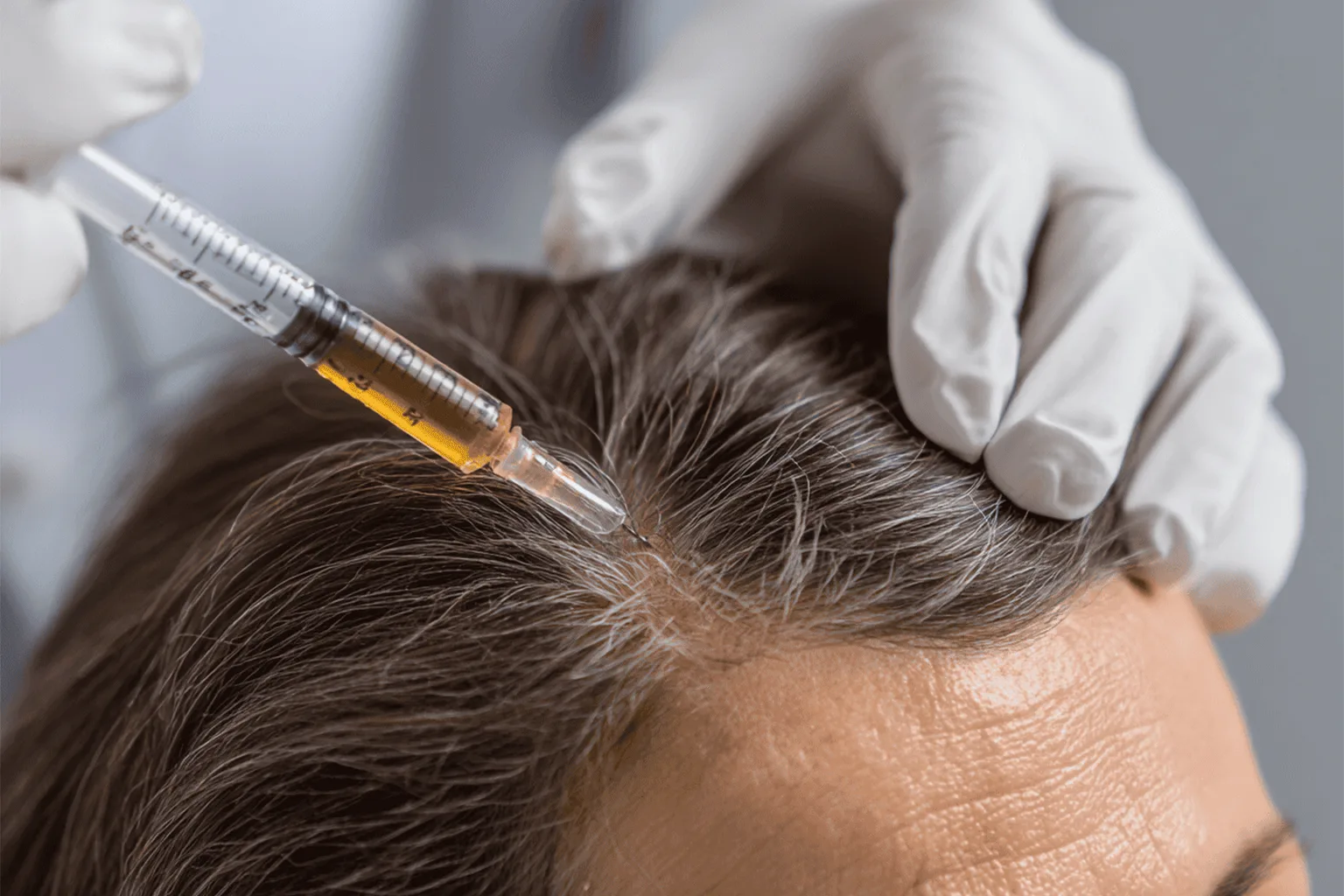
SVF (stromal vascular fraction) is a mixed cell population obtained by processing a sample of a person’s own fat tissue; it contains connective tissue cells, vessel wall cells, immune cells and adipose-derived stem cells. In hair treatment, this mixture is injected into the thinning areas in a single session.
I do not use this method in my clinical practice; this page is for information. I do not use SVF for hair; the evidence is limited and the procedure is extensive — I state that plainly. For a single-session treatment that requires fat harvesting, the human data we have are not strong enough for me to place it ahead of less extensive options. I keep this page so that people researching the method find accurate information.
I am a specialist in anaesthesiology and reanimation; sterile technique, local anaesthesia and injection safety are core areas of my training. I assess hair treatments within this framework. The types of hair loss and the steps of treatment are on the hair loss treatment page.
How is it done?
The procedure has three stages: harvesting a small amount of fat from the abdomen or hips under local anaesthesia, processing the fat tissue in a closed system to separate the cell mixture, and injecting the resulting mixture into the scalp. Together the three stages take about 1.5 hours and are completed in a single session. Because I have no data for a maintenance plan, I give no maintenance figure on this page.
The fat tissue is not cultured and does not leave the clinic; the procedure is completed within the same appointment.
How is it thought to work?
Besides fat cells, fat tissue contains vessel wall cells, immune cells and mesenchymal stem cells. The contribution of these cells is thought to come mainly from the growth factors and signalling molecules they release — that is, through a paracrine effect; on the scalp, the aim is for them to carry signals to the tissue around the follicle. How far this translates into clinical results in hair has been studied only to the extent described below. The general definition of SVF, how it is obtained and its other applications are on the SVF therapy page.
Its relationship with drug treatment
In hereditary hair loss, the treatments with the highest level of evidence are topical and oral drug treatments. I plan injection methods alongside these treatments, not instead of them; we assess the suitability and follow-up of drug treatment together at consultation.
Being honest about the level of evidence
Human data on SVF in hair are scarce. A 2026 systematic review of regenerative methods found four studies on SVF covering 46 people in total; only one of them is a randomised controlled trial. That trial, in which SVF was given together with PRP, comes from a research group that includes the review’s first author. The review notes that cell content and preparation methods are not standardised across studies and that standardisation is needed 1. The reported side effects were mild and transient; however, this observation rests on small numbers of patients.
What this means: it has not been shown that SVF does not work in hair, but nor are there data strong enough to recommend a single-session treatment that requires fat harvesting. Claims about graft survival rates, hair loss stopping or scar-free healing have no source; I do not make them. This page will be updated when stronger data become available.
How it compares with the other methods
Among the injection methods I use for hair loss, PRP is the one whose randomised trials have been assessed in meta-analyses; the certainty of that evidence is low 2. If you are looking for a tissue-derived treatment completed in a single session, autologous micrografts — made with small tissue samples taken from behind the ear — are the option I consider before SVF, because they require no fat harvesting and have a placebo-controlled study.
- Blood-derived option given as a series: PRP for hair
- Tissue-derived single-session option: autologous micrograft hair therapy
This comparison is here not to disparage SVF, but to show that less extensive options with more established evidence exist for the same goal.
The procedure and pain management
Because I am an anaesthesiologist, I treat pain management as a separate part of the procedure.
Topical anaesthetic cream is not used routinely on the scalp; for very sensitive people it is applied before the treatment. What you feel is a brief sting. Fat harvesting is done under local anaesthesia; what you feel is a brief sting while the anaesthetic is given. Mild pain and tenderness at the site may last a few days.
Aftercare
First 24 hours
- Do not wash your hair (you can wash it the next day)
- No hot showers, sauna, hammam or steam
- Avoid heavy exercise
- No alcohol
- Do not touch the injection points; do not squeeze or massage the bumps
First 48 hours
- Avoid direct and prolonged sun exposure; wear a hat outdoors
Expected findings Mild redness and tenderness at the injection points are expected and settle the same day. Small bruises may last 1–2 days.
Additional advice
- Wait 2–3 days before hair dye and similar chemical treatments
- If redness increases, or warmth or fever develops, contact the clinic
- Mild pain, bruising and swelling at the fat harvest site may last a few days; a short period of compression may be advised
- No heavy exercise for 1 week
Safety and anatomy
Because allergic reactions can occur rarely, treatments are carried out under medical supervision.
Among the methods I describe for hair loss, SVF is the only one that requires fat harvesting. Fat harvesting is not an operation requiring general anaesthesia; it is a minor procedure performed under local anaesthesia. Even so, it requires assessment for vessel and tissue injury, infection and healing problems; the risk of infection is low but not zero. The cells are your own; the system is closed and sterile. Temporary redness, tenderness and small bruises may occur at the injection points; the expected durations are given in the aftercare section.
Regulatory status: The closed, single-use disaggregation kits are medical devices assessed under CE and TİTCK frameworks. Approval belongs to a product and to a specific indication, not to a technique or to a physician.
Who is not suitable
Treatment is not performed, or is postponed, in the following situations:
- Active infection or inflammation in the treatment area
- Autoimmune disease in an active phase
- Pregnancy and breastfeeding
- Known hypersensitivity to the product components
- Uncontrolled chronic illness
- Untreated bleeding disorder or unregulated anticoagulant use
I do not perform these treatments during active cancer treatment. For a person with a history of cancer, I make the decision together with the treating specialist.
Treatment is postponed if there is an open wound or an active flare of seborrhoeic dermatitis on the scalp, and in the early period after a hair transplant; injections are not given in alopecia areata during an active phase.
Treatment is also not performed with a known hypersensitivity to the local anaesthetics used for fat harvesting.
For a person on immunosuppressive treatment, the decision is made at consultation.
Treatment is not performed when fat tissue is insufficient or in uncontrolled diabetes.
Without being a medical contraindication, I also consider expectation and treatment to be mismatched in these situations:
- People expecting hair to grow in an area where the follicle has been lost completely and the skin is smooth — a hair transplant is considered in that situation
- People expecting a marked and lasting change from a single session
- People who do not accept fat harvesting
Suitability is determined by consultation in every case.
Frequently asked questions
Does SVF produce hair where there is baldness?
No. In areas where the follicle has been lost completely and the skin is smooth, no injection method will produce hair, and neither will SVF. These methods aim to thicken existing but miniaturised hairs and to slow the shedding.
Does the hair need to be shaved for SVF hair therapy?
No. The injection is given into the scalp with fine needles; the hair does not need to be cut or shaved. No hair-related preparation is needed for the fat harvest site either.
Is there a cancer risk with SVF hair therapy?
The applied cells come from your own tissue and are not expanded in culture; however, there are not enough data on the long-term safety of adipose-derived cells in people with a history of cancer. I do not perform these treatments during active cancer treatment. For a person with a history of cancer, I make the decision together with the treating specialist.
Why do I not use SVF for hair?
Because the human data I have are not strong enough to recommend a single-session treatment that requires fat harvesting. There are less extensive options with more established evidence for the same goal, and I recommend those first. I do not add a procedure I do not consider necessary just because it is requested.
Planning your visit
My clinic is in Nişantaşı, Şişli, on the European side of Istanbul, approximately 45 minutes from Istanbul Airport.
For hair loss treatments I suggest planning a stay of two to three days: arrival, consultation and treatment, and departure. I do not use SVF for hair; the treatments I do offer for hair loss are on the hair loss treatment page. Flying is generally appropriate 24 hours after an injectable treatment.
Consultations are conducted in English. Follow-up after you return home is arranged remotely, and I remain reachable for any questions during the period in which the result develops.
Dr. Ömer Fatih Şahin — Specialist in Anaesthesiology and Reanimation Diploma Registration No: 113606
Published: 22 February 2026 · Last updated: 2026-09-21 This content has been medically reviewed by Dr. Ömer Fatih Şahin.
References
- Behrangi E, Amiri S, Zeinali R, et al. A systematic review of clinical evidence on the efficacy and safety of conditioned media, platelet-rich fibrin, stromal vascular fraction, extracellular vesicles, and stem cells in androgenetic alopecia. Stem Cell Res Ther. 2026;17:194. https://pubmed.ncbi.nlm.nih.gov/41987228/
- Kieling L, Konzen AT, Zanella RK, Valente DS. Is autologous platelet-rich plasma capable of increasing hair density in patients with androgenic alopecia? A systematic review and meta-analysis of randomized clinical trials. An Bras Dermatol. 2024;99(6):847–862. https://pubmed.ncbi.nlm.nih.gov/39013743/