
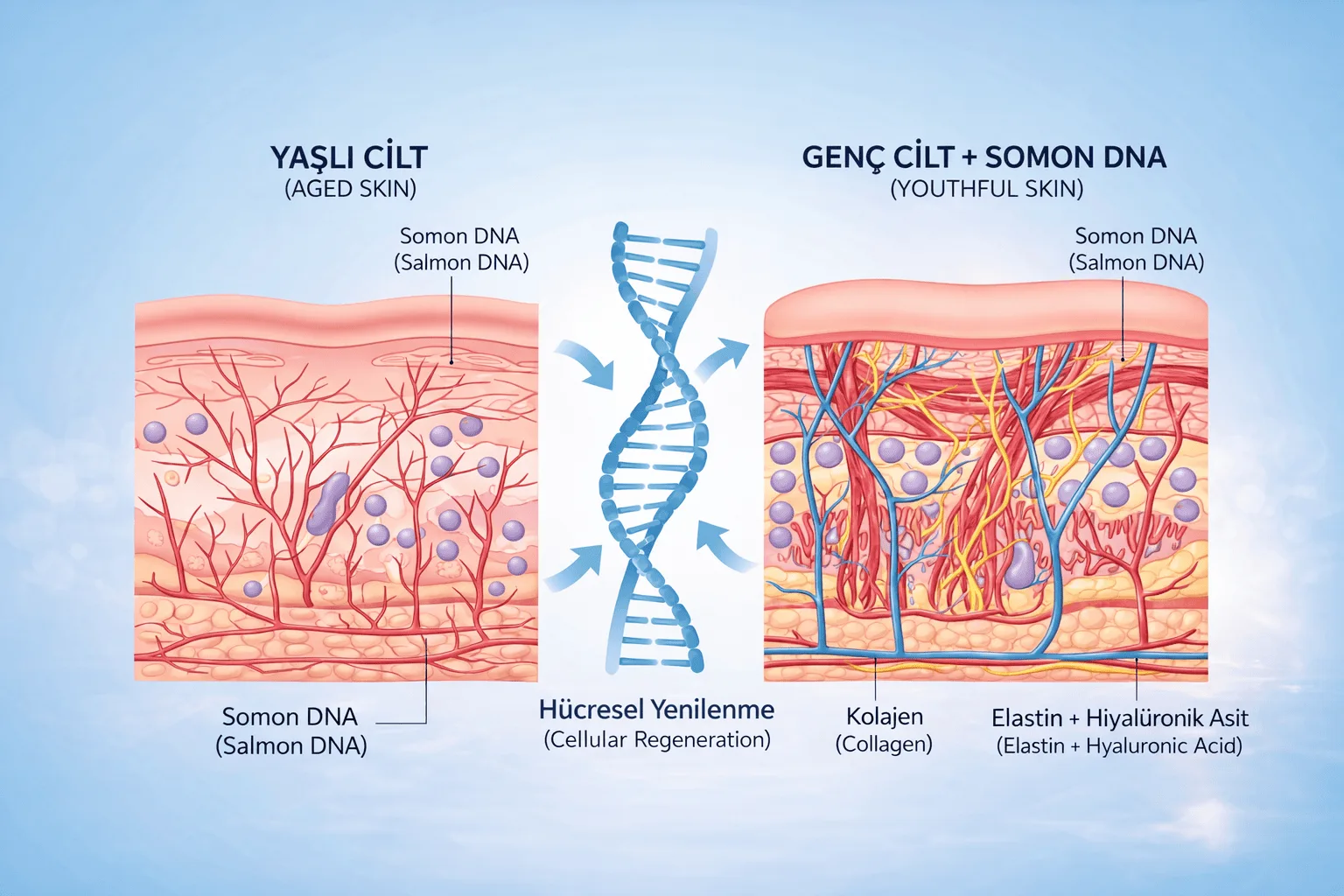
Plinest and Newest are three forms of a product family in the polynucleotide (PN) class: polynucleotides purified from salmon DNA. Plinest is prepared for the full face and Plinest Eye for the eye area; Newest is the hydration-focused form in which polynucleotide is combined with hyaluronic acid. None of them is a filler; they add no volume and do not reshape the face. Within this class I work with products that have traceability and a certificate of analysis; I use all three forms.
The general framework of the polynucleotide class — the difference from PDRN, the level of evidence, where the lines are between classes, the comparison of product families — is on the salmon DNA (polynucleotide) treatment page. Here I cover this family only.
Three forms, three needs
Plinest. The standard form of the family, placed in the dermis of the full face by micro-injection. Used for thinning, loss of elasticity, superficial scarring and pore visibility.
Plinest Eye. The form prepared for the thin skin of the eye area; according to the manufacturer it is more fluid. Used under the eyes for thin skin, dark circles and crepey texture.
Around the eyes the decision depends on the cause: if hollowing dominates, mesotherapy is not enough and filler is discussed; if thin skin, dark circles and mild puffiness dominate, HA–amino acid biorevitalisers or polynucleotide products come forward. The product is chosen at the consultation.
The whole of the under-eye picture — the sources of dark circles, blood tests, the boundary with light filler — is on the under-eye polynucleotide treatment page; the decision framework there applies to Plinest Eye as well.
Newest. According to the manufacturer, the form containing polynucleotide, non-cross-linked hyaluronic acid and mannitol. The polynucleotide supports the skin’s repair processes while the HA holds moisture at the surface. Used for dry, dull, dehydrated skin and for the neck and décolletage. The HA in Newest is not a filler: it is non-cross-linked and adds no volume.
The decision depends on the type of problem: if thinning, scarring and pores lead, Plinest; if dryness and dullness lead, Newest comes to the fore. The final choice is made at consultation.
I do not routinely layer Plinest and Newest on the same skin; if the need is met by one form, I do not add the second.
How does it work?
The product is placed in the dermis by spread micro-injection. Long-chain polynucleotides are reported to form a water-holding network that provides structural support and to play a role in remodelling the extracellular matrix 2. It has been suggested that the receptor mechanism described for short-chain PDRN also applies to polynucleotides, but this has not yet been demonstrated scientifically 1.
To be open about the evidence: alongside studies reporting improvement in skin texture and elasticity with polynucleotides, the literature includes studies reporting limited or no benefit 1. That is why I give no percentages. The product does not remain in the tissue; it does its repair work and is metabolised.
Who is it suitable for?
- Skin that is beginning to thin and lose elasticity (Plinest)
- Superficial acne scarring and enlarged pores (Plinest)
- Thin skin and dark circles under the eyes (Plinest Eye)
- Dry, dull, dehydrated skin; the neck and décolletage (Newest)
- Anyone who does not want volume and wants their face shape left alone
Which method leads for which problem on the neck and décolletage is on the neck and décolletage rejuvenation page.
Session plan and what to expect
- 3 sessions, 3 weeks apart. I plan the same protocol for all three forms.
- Hydration and a sense of relief after the first session; the tissue effect becomes visible after the second.
- The effect lasts around 9 months. Maintenance is a single session, planned by tissue response rather than by calendar.
I do not assess the result before the three-session course is complete.
The procedure and pain management
The procedure takes 15–20 minutes; the product is placed in the dermis by spread micro-injection with a fine needle or with a cannula; around the eyes a fine needle or cannula is preferred.
Topical anaesthetic cream is standard. Because I am an anaesthesiologist, I treat pain management as a separate part of the procedure. The procedure is well tolerated; a mild pressure sensation is normal.
Aftercare
First 24 hours
- No make-up on the treated area
- No hot showers, sauna, hammam or steam
- Avoid heavy exercise
- No alcohol
- Do not sleep face-down (facial treatments)
- Do not touch the injection points; do not squeeze or massage the bumps
First 48 hours
- Avoid direct and prolonged sun exposure
- No facial massage, skincare treatments or energy-based device treatments
Expected findings Small bumps (papules) at the injection points lasting 12–24 hours are expected and show that the product has settled in the skin. Mild swelling, tenderness or bruising lasting a few days may occur. Around the eyes, bruising is slightly more likely than on the rest of the face.
Safety and anatomy
The products are salmon-derived and produced at high purity. Papules, temporary swelling, tenderness and bruising can occur at injection points. The eye area is densely vascular; using a fine needle or cannula lowers the chance of bruising. Polynucleotide is not a substance that is dissolved with an enzyme the way hyaluronic acid fillers are; it does not remain in the tissue and is metabolised. Sterile technique is used, and treatment is postponed if there is an active infection.
Because allergic reactions can occur rarely, treatments are carried out under medical supervision.
Product and regulatory status: Plinest, Plinest Eye and Newest have been assessed under CE and TİTCK frameworks for their relevant indications. Approval belongs to the product and to a specific indication, not to a technique or to a physician.
Who is not suitable
Treatment is not performed, or is postponed, in the following situations:
- Active infection or inflammation in the treatment area
- Autoimmune disease in an active phase
- Pregnancy and breastfeeding
- Known hypersensitivity to the product components
- Uncontrolled chronic illness
- Untreated bleeding disorder or unregulated anticoagulant use
Because the product is salmon-derived, treatment is also not performed in people with a known serious allergy to fish or salmon protein.
Without being a medical contraindication, I also consider expectation and treatment to be mismatched in these situations:
- People expecting a marked and immediate change from a single session
- People whose actual need is volume — polynucleotide treatment does not add volume, and filler is assessed
- People with under-eye hollowing — polynucleotide does not fill a hollow
Suitability is determined by consultation in every case.
Pricing
Under the applicable regulations, price information cannot be published on our website. The cost of a treatment depends on the product used, the technique chosen and the extent of the treatment. You can call the clinic for detailed information.
Frequently asked questions
What is the difference between Plinest and Newest?
Plinest is pure polynucleotide; it leads for thinning, scarring and pores. Newest combines polynucleotide with non-cross-linked hyaluronic acid; it leads for dryness and dullness. The decision depends on the type of problem; the final choice is made at consultation.
When is Plinest Eye chosen?
When thin skin, dark circles and crepey texture lead under the eyes. If there is a hollow, polynucleotide is not enough and filler is discussed.
Is the hyaluronic acid in Newest a filler?
No. The HA in Newest is non-cross-linked; it adds no volume and holds moisture at the surface. Filler HA is cross-linked and stays where it is placed to create volume; they are different products.
Why are Plinest and Newest not done together?
If the need is met by one form, I do not add the second: either thinning and scarring or dryness leads. I do not make the two a routine package, and I do not recommend a procedure I do not think is needed. Where both needs are present, we build the plan at consultation.
Planning your visit
My clinic is in Nişantaşı, Şişli, on the European side of Istanbul, approximately 45 minutes from Istanbul Airport.
For a Plinest or Newest treatment I suggest planning a stay of two to three days: arrival, consultation and treatment, and departure. Because this treatment is planned as three sessions three weeks apart, it requires more than one visit. The first session takes place in Istanbul, and we plan the schedule of the following sessions together according to your travel arrangements, with remote follow-up in between. Flying is generally appropriate 24 hours after an injectable treatment.
Consultations are conducted in English. Follow-up after you return home is arranged remotely, and I remain reachable for any questions during the period in which the result develops.
Dr. Ömer Fatih Şahin — Specialist in Anaesthesiology and Reanimation Diploma Registration No: 113606
Published: 22 February 2026 · Last updated: 2026-09-21 This content has been medically reviewed by Dr. Ömer Fatih Şahin.
References
- Lee KWA, Chan KWL, Lee A, et al. Polynucleotides in Aesthetic Medicine: A Review of Current Practices and Perceived Effectiveness. Int J Mol Sci. 2024;25(15):8224. https://pubmed.ncbi.nlm.nih.gov/39125793/
- Kim ST. Comparison of Polynucleotide and Polydeoxyribonucleotide in Dermatology: Molecular Mechanisms and Clinical Perspectives. Pharmaceutics. 2025;17(8):1024. https://pubmed.ncbi.nlm.nih.gov/40871045/