
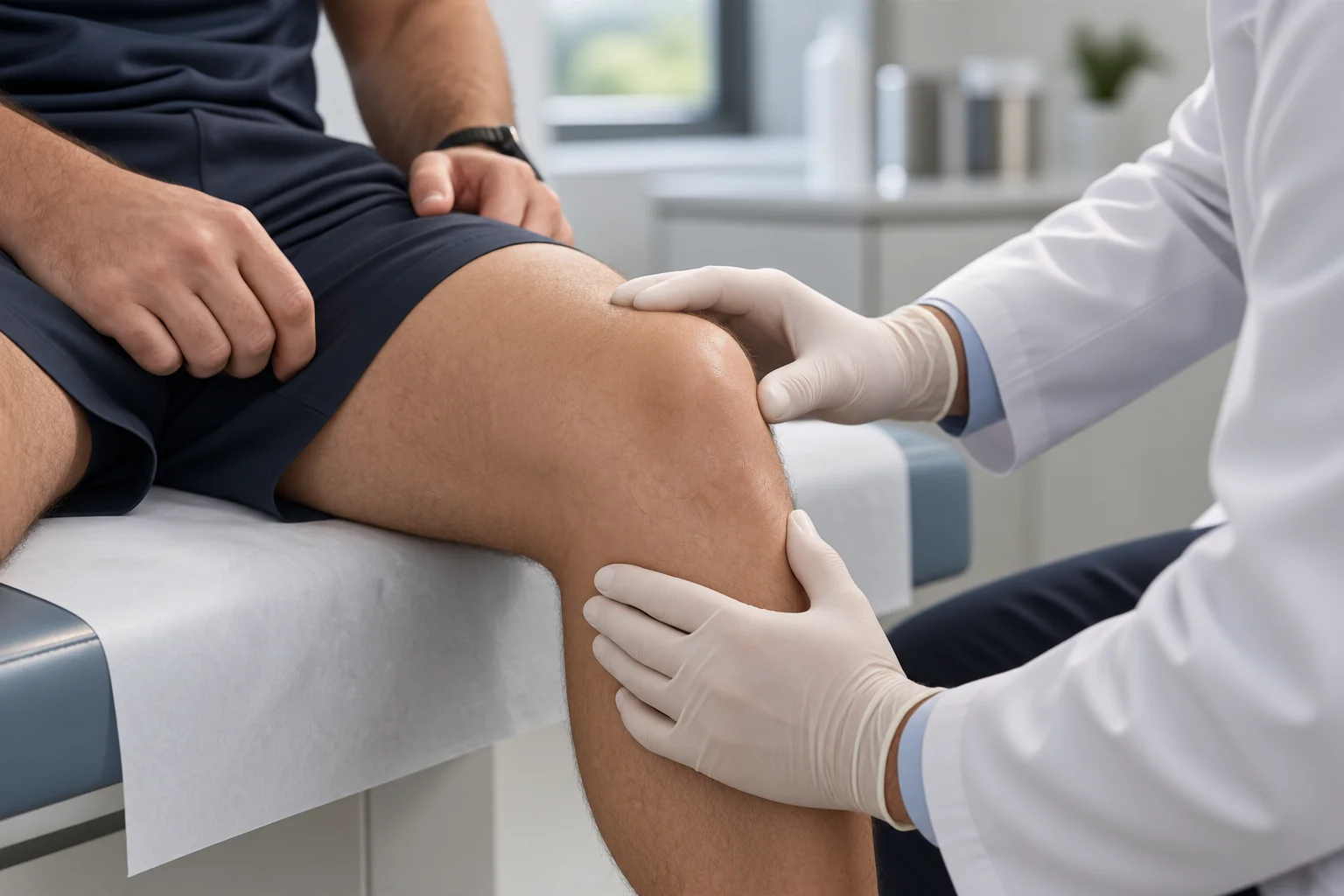
A knee hyaluronic acid injection — sometimes called “gel injection” or “joint fluid supplementation” — places hyaluronic acid, a natural component of joint fluid, into the knee joint; its medical name is viscosupplementation. In osteoarthritis I use it once inflammation has settled and the pain continues as friction and stiffness, to support lubrication. I perform the intra-articular injection as an anaesthesiologist and plan pain control as part of the procedure.
I do not recommend hyaluronic acid for every knee; I discuss its limited benefit in the literature with the patient, and we decide together. This page explains what it does and does not do, its evidence level and in which knees it comes up. The overall framework of the methods I use for pain is on the pain treatment page.
What it does — and does not do
Healthy joint fluid is thick and slippery; in osteoarthritis it thins and lubrication falls. The injected hyaluronic acid is intended to support the lubricating quality of joint fluid and to reduce pain perception through receptors in the joint lining. The injected material is metabolised in the joint within weeks, so the effect is attributed less to its physical presence than to the change it sets off in the joint environment.
What it does not do: it does not rebuild cartilage, does not reverse wear and does not settle active inflammation. It is not the first option for a knee that is swollen and warm.
The evidence — an honest picture
Knee hyaluronic acid is a treatment with contested evidence, and I do not hide that. A recent meta-analysis pooling large placebo-controlled trials found that the reduction in pain compared with placebo was statistically significant but below the threshold considered clinically meaningful, and reported a slightly higher rate of serious adverse events than placebo 1. The American College of Rheumatology’s 2026 update also recommends conditionally against intra-articular hyaluronic acid in the knee 2. There are also reviews reporting benefit in selected patients; the authors of those reviews are affiliated with institutions and study groups focused on the field of hyaluronic acid 3.
My conclusion from this picture: hyaluronic acid is not a first-line option but an option in selected patients. It comes up in early and intermediate osteoarthritis once inflammation has settled, in patients who cannot use pain-relief medication, or in whom I do not want to repeat corticosteroid frequently. I set expectations realistically from the start: the effect is modest, varies from person to person and is limited in duration.
In which knees does it come up?
- Early and intermediate osteoarthritis, once inflammation has settled and pain continues as friction and stiffness
- Patients who cannot take regular pain-relief medication because of stomach, kidney or heart conditions
- Patients in whom I do not want to repeat corticosteroid injections frequently
- Knees where a Sanakin course has been completed, inflammation has settled and lubrication support is wanted
Sanakin or hyaluronic acid?
In the knee, the decision depends on the state of the joint: in the active phase, when pain and swelling are the main issue, serum prepared from the patient’s own blood comes to the fore; once inflammation has settled and lubrication support is wanted, intra-articular hyaluronic acid does. They are not given in the same session; when needed they are planned in sequence. The final choice is made at consultation.
The option for the active phase is described on the Sanakin for knee osteoarthritis page. Intra-articular ozone is on the knee ozone therapy page.
Product class and how it is given
Intra-articular hyaluronic acid products come in two main classes: linear (non-cross-linked) and cross-linked. Depending on the product, either a single injection or a series of three weekly injections is planned; I choose the class according to the state of the joint at consultation. Studies have reported the effect lasting up to a few months; it varies from person to person 13. Whether to repeat is decided by the response and the duration, not by a calendar.
The procedure and pain management
Topical anaesthetic cream is standard. Because I am an anaesthesiologist, I treat pain management as a separate part of the procedure.
In an intra-articular injection, what you feel is a brief sting followed by a mild feeling of fullness. The injection takes a few minutes; if there is fluid in the joint it is drained first.
Safety and anatomy
Sterile technique is essential for intra-articular injection; the risk of infection is low but not zero. Temporary pain and swelling can occur after the injection; rarely, a reactive response with marked swelling in the days after injection has been reported — in that case the clinic should be contacted and the joint assessed. Some products contain hyaluronic acid of avian origin; a known allergy to bird protein or egg is asked about at the first consultation. Because allergic reactions can occur rarely, treatments are carried out under medical supervision.
Product status: This product class consists of products assessed within the scope of CE and TİTCK for the relevant indications. Intra-articular hyaluronic acid products fall within the scope of medical devices.
Who is not suitable
Treatment is not performed, or is postponed, in the following situations:
- Active infection or inflammation in the treatment area
- Autoimmune disease in an active phase
- Pregnancy and breastfeeding
- Known hypersensitivity to the product components
- Uncontrolled chronic illness
- Untreated bleeding disorder or unregulated anticoagulant use
I do not perform these treatments during active cancer treatment. For a person with a history of cancer, I make the decision together with the treating specialist.
Treatment is not performed with a joint or skin infection; with products of avian origin, known avian protein or egg allergy is asked about.
Without being a medical contraindication, I also consider expectation and treatment to be mismatched in these situations:
- People with an actively inflamed, swollen and warm knee — the inflammation is addressed first
- People expecting a lasting result from a single injection
- People with advanced osteoarthritis who need surgery — an injection does not replace surgery
Suitability is determined by consultation in every case.
Aftercare
Same day
- Walking is fine
First 24–48 hours
- Avoid running, squatting, frequent stair use and heavy loads
- No hot showers, sauna or hammam for 48 hours
Expected findings Mild pain, a feeling of fullness and slight swelling may occur for 1–2 days; brief cold application is enough. If swelling increases markedly, or redness or fever develops, contact the clinic.
Pricing
Under the applicable regulations, price information cannot be published on our website. The cost of a treatment depends on the product used, the technique chosen and the extent of the treatment. You can call the clinic for detailed information.
Frequently asked questions
What does hyaluronic acid do in the knee?
It is intended to support the lubricating quality of joint fluid and to reduce pain perception through the joint lining. It does not rebuild cartilage, does not reverse wear and does not settle active inflammation.
Is knee hyaluronic acid a single injection or a series?
It depends on the product: linear products are usually given as a series of three weekly injections, cross-linked products as a single injection. I choose the class according to the state of the joint at consultation.
How long does knee hyaluronic acid last?
Studies have reported an effect lasting up to a few months; it varies from person to person. Whether to repeat is decided by the response and the duration.
Does knee hyaluronic acid actually work?
The evidence is contested. In a large meta-analysis the reduction in pain compared with placebo was significant but clinically small, with a slightly higher rate of serious adverse events; the current guideline also recommends conditionally against it in the knee. There are reviews reporting benefit in selected patients, but their authors are affiliated with institutions focused on the field. That is why I do not recommend it for every knee; we discuss the limited benefit and decide together.
Planning your visit
My clinic is in Nişantaşı, Şişli, on the European side of Istanbul, approximately 45 minutes from Istanbul Airport.
For a knee hyaluronic acid injection I suggest planning a stay of two to three days: arrival, consultation and treatment, and departure. Because this treatment may be planned as more than one session, it may require more than one visit. The first session takes place in Istanbul, and we plan the schedule of any following sessions together according to your travel arrangements, with remote follow-up in between. Flying is generally appropriate 24 hours after an injectable treatment.
Consultations are conducted in English. Follow-up after you return home is arranged remotely, and I remain reachable for any questions during the period in which the result develops.
Dr. Ömer Fatih Şahin — Specialist in Anaesthesiology and Reanimation Diploma Registration No: 113606
Published: 2026-02-22 · Last updated: 2026-09-28 This content has been medically reviewed by Dr. Ömer Fatih Şahin.
References
- Pereira TV, Jüni P, Saadat P, et al. Viscosupplementation for knee osteoarthritis: systematic review and meta-analysis. BMJ. 2022;378:e069722. https://pubmed.ncbi.nlm.nih.gov/36333100/
- American College of Rheumatology. 2026 Update of the American College of Rheumatology Recommendations for the Management of Osteoarthritis of the Knee, Hip, and Hand (guideline summary). 14 September 2026. https://rheumatology.org/osteoarthritis-guideline
- Glinkowski WM, Tomaszewski W. Intra-articular hyaluronic acid for knee osteoarthritis: a systematic umbrella review. J Clin Med. 2025;14(4):1272. https://pubmed.ncbi.nlm.nih.gov/40004802/ — The authors are affiliated with institutions and study groups focused on the field of hyaluronic acid.