
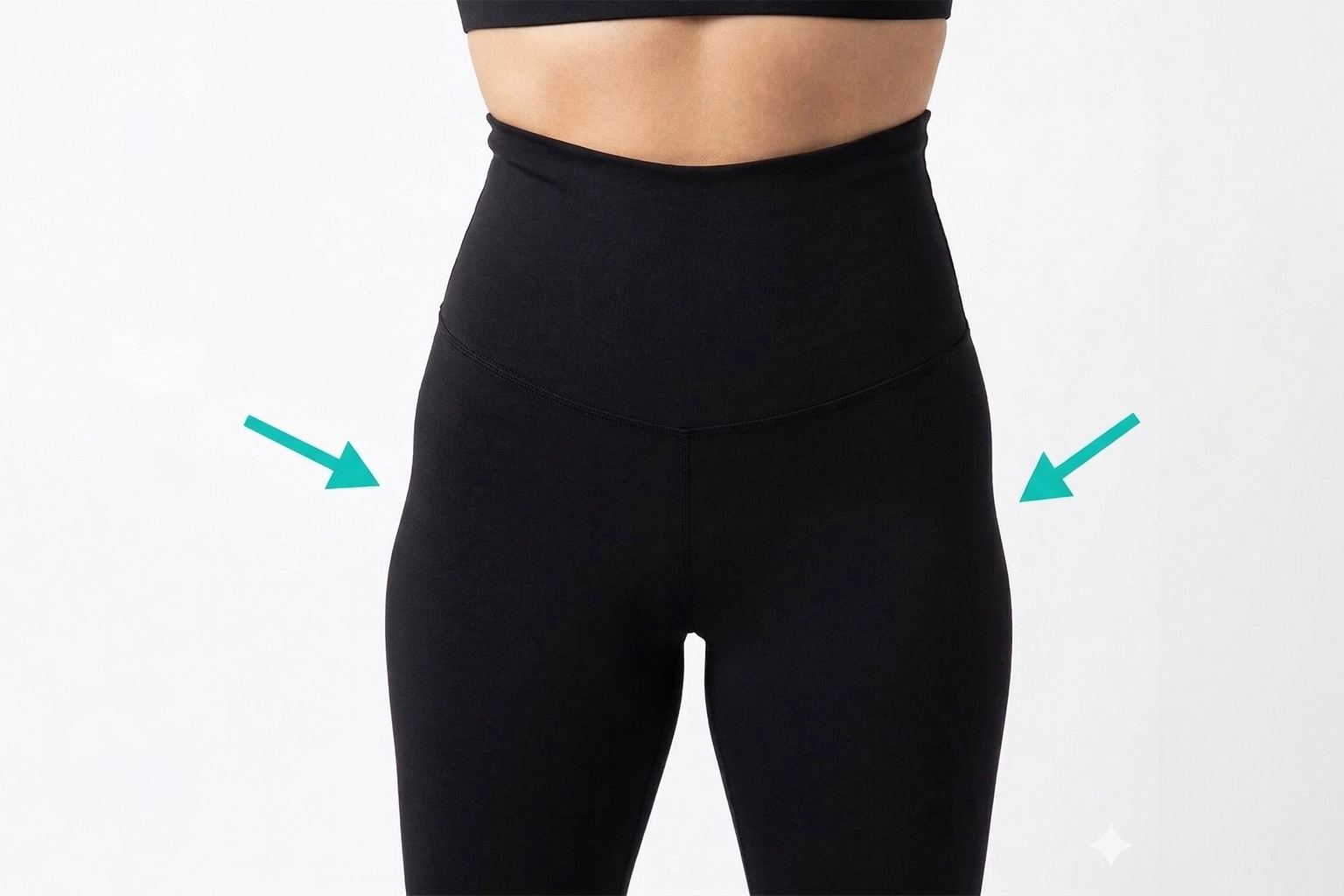
Hip dips are the inward curves visible between the hip bone and the upper part of the thigh bone. They appear as an indentation along the side of the hip, between the waist and the thigh.
On this page I explain why hip dips occur, when treatment is appropriate, and my approach to this area. The product class I use (PLLA) and the product pages are given below.
Why do hip dips occur?
Hip dips are not a disease, a flaw or a weight problem. They are related to bone structure.
The width of the pelvis, the position of the head of the thigh bone and the distance between these two bones differ from person to person. When that distance is wide, the muscle and fat tissue in between cannot follow the outer line of the bone, and an inward indentation appears.
This is why the appearance of hip dips is largely determined by skeletal structure. Losing weight can make the indentation more noticeable because there is less fat tissue in the area; gaining weight does not always close it, because fat tissue is not the underlying cause.
Hip dips are a very common appearance.
Can exercise get rid of them?
They can change to a degree, but they do not disappear completely.
Training the muscle group in this area — particularly the gluteus medius on the side of the hip — can build volume and soften the appearance of the indentation somewhat. This does not mean exercise is pointless. But an indentation caused by bone structure cannot be fully closed with muscle volume.
I see many patients who blame themselves for not getting a result from exercise. Understanding the cause tends to be a relief at that point: what is missing here is not effort, but anatomy.
My approach to this area
Hip dips are one of the areas where biostimulator treatments make sense on the body. What matters here is not millimetric symmetry but a gradual tissue response across a wide area — and that is what products containing poly-L-lactic acid (PLLA) do well by nature 1.
The aim is not to fill the area but to increase collagen support in the surrounding tissue so that the transition softens. The result is not a sharp fullness but a more flowing line.
The products I use belong to the PLLA class. Two products from this class have their own detailed pages, where the massage protocols are also given: PLLA with a 14-day massage protocol and PLLA with the 5-5-5 massage protocol. For the general framework of biostimulator treatments, see the liquid facelift page.
This treatment is not suitable for everyone. The depth of the indentation, skin thickness, the amount of tissue in the area and your expectations determine suitability. In some patients I do not believe a meaningful change can be achieved because of the anatomical structure, and I say so clearly during consultation.
Is this an alternative to fat transfer?
They are different methods, suited to different patients.
Fat transfer is a surgical procedure. It requires harvesting fat from another area of the body, processing it and transferring it to the target area. It requires an operating theatre and anaesthesia, recovery takes longer, and in return it can produce a more marked change in volume in a single session.
A biostimulator treatment is an injectable method. It does not require an operating theatre and you return to daily life the same day; in return the result develops gradually and the change it produces is more measured.
If you are expecting a marked increase in volume, this treatment may not meet your expectations. We discuss this during consultation.
How the treatment is performed
During consultation I assess the area standing and in movement; the indentation cannot be judged accurately when looking at it lying down.
Topical anaesthetic cream is standard. Because I am an anaesthesiologist, I treat pain management as a separate part of the procedure.
I place the product with a cannula in the correct layer. The treatment takes around 45–60 minutes. You can return to daily life the same day.
The number of sessions is planned individually; the width of the area and the tissue response are decisive.
When the effect appears: The collagen response becomes noticeable within 4–6 weeks. In body areas the tissue response is slower than on the face and can continue developing up to the sixth month.
Duration: On average two years, and potentially longer depending on the individual.
Massage protocol
Massage is required after PLLA treatment in this area. It ensures the particles distribute evenly through the tissue.
The protocol differs by product; its duration and frequency are set out on each product’s own page. A protocol should not be followed without knowing which product was used. I provide the protocol for the product used in writing at the end of your appointment.
Aftercare
First 24 hours
- No make-up on the treated area
- No hot showers, sauna, hammam or steam
- Avoid heavy exercise
- No alcohol
- Do not sleep face-down (facial treatments)
First 48 hours
- Avoid direct and prolonged sun exposure
- No facial massage, skincare treatments or energy-based device treatments
First week
- Avoid intensive lower-body training after body treatments
Expected findings Mild swelling, tenderness or bruising lasting a few days is expected. Part of the fullness seen in the first days is due to swelling and the product’s carrier and settles quickly; this does not mean the effect has worn off.
Safety and anatomy
The most common findings are temporary swelling, bruising and tenderness.
Small palpable firmness under the skin is uncommon. It is usually not visible from the outside and softens over time. Following the massage protocol reduces this possibility.
This product class cannot be dissolved with hyaluronidase. For this reason the treatment plan, the choice of layer and the choice of cannula are the most decisive parts of the procedure. Distance from vascular structures in the area and the correct anatomical plane are what determine the safety of the treatment.
Because allergic reactions can occur rarely, treatments are carried out under medical supervision.
Who is not suitable
Treatment is not performed, or is postponed, in the following situations:
- Active infection or inflammation in the treatment area
- Autoimmune disease in an active phase
- Pregnancy and breastfeeding
- Known hypersensitivity to the product components
- Uncontrolled chronic illness
- Untreated bleeding disorder or unregulated anticoagulant use
Without being a medical contraindication, I also consider expectation and treatment to be mismatched in these situations:
- People expecting a marked increase in volume from a single session
- People unable to follow the massage protocol
- People whose indentation is very pronounced and where no meaningful anatomical change is expected
I am not comfortable with excessive treatment requests. If I do not believe a result can be achieved in this area, I do not recommend the treatment. Suitability is determined by consultation in every case.
Pricing
Under the applicable regulations, price information cannot be published on our website. The cost of a treatment depends on the product used, the technique chosen and the extent of the treatment. You can call the clinic for detailed information.
Planning your visit
My clinic is in Nişantaşı, Şişli, on the European side of Istanbul, approximately 45 minutes from Istanbul Airport.
For this treatment I suggest planning a stay of two to three days: arrival, consultation and treatment, and departure. Flying is generally appropriate 24 hours after an injectable treatment.
Because the result in this area develops over months, we plan the timing of any further sessions together according to your travel schedule. Consultations are conducted in English, and follow-up after you return home is arranged remotely.
Frequently asked questions
Are hip dips a medical condition?
No. Hip dips are an anatomical appearance caused by the distance between the pelvis and the thigh bone. They are not a flaw, a disease or a weight problem.
Can exercise get rid of hip dips?
Not completely. Training the muscle group on the side of the hip can build volume and soften the appearance of the indentation somewhat. But an indentation caused by bone structure cannot be fully closed with muscle volume.
Is a biostimulator treatment an alternative to fat transfer?
They are different methods. Fat transfer is a surgical procedure requiring an operating theatre and anaesthesia, with a longer recovery, and in return it can produce a more marked change in volume in a single session. A biostimulator treatment is an injectable method allowing return to daily life the same day, but the result develops gradually and the change is more measured. Which is appropriate depends on expectations and anatomy.
When are hip dips treatment results visible?
The collagen response becomes noticeable within 4–6 weeks. In body areas the tissue response is slower than on the face and can continue developing up to the sixth month. The fullness seen immediately after treatment belongs to the carrier fluid and settles within a few days.
Dr. Ömer Fatih Şahin — Specialist in Anaesthesiology and Reanimation Diploma Registration No: 113606
Last updated: 2026-09-21 This content has been medically reviewed by Dr. Ömer Fatih Şahin.
References
- Christen MO. Collagen Stimulators in Body Applications: A Review Focused on Poly-L-Lactic Acid (PLLA). Clin Cosmet Investig Dermatol. 2022;15:997–1019. https://pubmed.ncbi.nlm.nih.gov/35761856/