
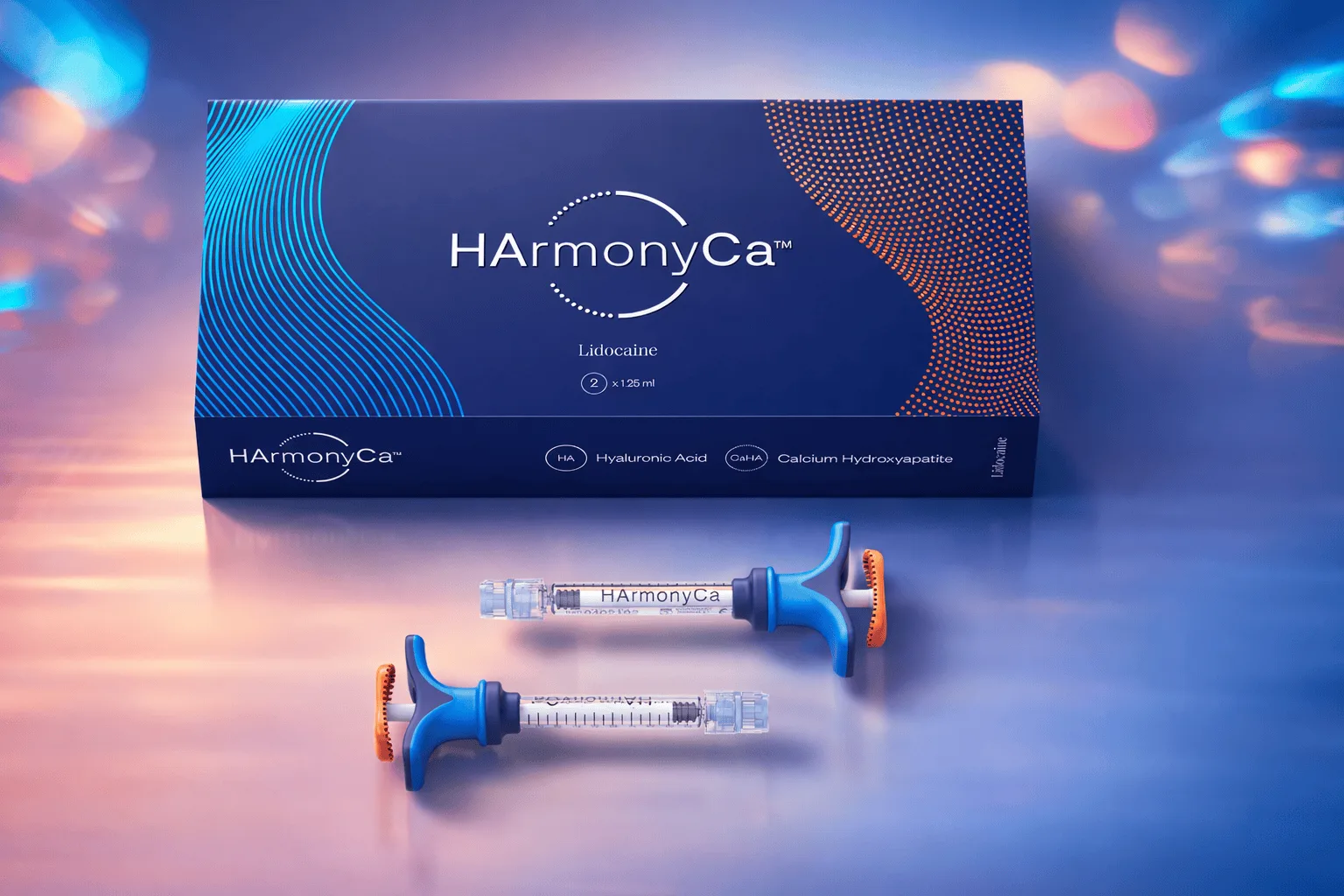
HarmonyCa is a hybrid product containing both hyaluronic acid and calcium hydroxylapatite. Because it carries the properties of two different classes, one question comes up often: is this a filler or a biostimulator?
The answer is both. On this page I explain which patients this product actually makes sense for.
Two components, two different effects
To understand how HarmonyCa behaves, the two components need to be considered separately.
The hyaluronic acid component provides tissue support at the time of treatment. This is classical filler behaviour — it shows its effect immediately and is absorbed over time.
The CaHA component remains in the tissue and stimulates fibroblast cells to begin producing collagen 1. This effect begins to build 6–8 weeks after treatment.
So the product works in two stages: first the support provided by the hyaluronic acid, then the lasting tissue change taken over by collagen. The effect lasts on average 18–24 months.
Filler or biostimulator?
The answer depends on how the product is used.
I use HarmonyCa for tissue support in the lateral part of the face — in the cheek and lateral facial line, where laxity has begun but there is not yet a marked loss of volume.
I want to keep one distinction clear here: the support felt at the time of treatment comes from the hyaluronic acid component, while the change in skin quality comes from the CaHA component. Not confusing the two matters, because the patient’s expectations are shaped accordingly.
Who it suits:
| Need | Approach |
|---|---|
| Marked volume loss, contour and shaping | Hyaluronic acid filler |
| Skin quality, firmness, tissue quality | Pure biostimulator |
| Between the two — mild laxity plus a need for skin quality | HarmonyCa |
This product makes sense for the patient who falls between the two categories. If you have clear volume loss, a filler is the better choice; if you have a clear skin quality problem, a pure biostimulator is.
Do I use it for the jawline?
Providing tissue support in the lateral face and creating contour along the jawline are different tasks.
I use HarmonyCa for tissue support in the lateral facial area. When contour and shaping are needed along the jawline, I use hyaluronic acid fillers, which are reversible. The reason is safety: the CaHA component of HarmonyCa cannot be dissolved with an enzyme, which makes the product only partly reversible.
This is an important characteristic of the product, and I address it separately below.
A partly dissolvable product
Because of its hybrid structure, HarmonyCa differs from other biostimulators in one respect: the hyaluronic acid component can be dissolved with hyaluronidase, while the CaHA component cannot.
So if a correction is needed, part of the product can be addressed, but not all of it. This offers more flexibility than pure CaHA, but it does not provide the full reversibility of a hyaluronic acid filler.
I always explain this to patients before treatment, because it directly affects the decision.
How the treatment is performed
During consultation I assess the condition of the tissue in the lateral face, skin thickness and the degree of laxity.
Topical anaesthetic cream is standard. Because I am an anaesthesiologist, I treat pain management as a separate part of the procedure.
I place the product with a cannula in the deep layer. The treatment takes around 20–30 minutes. You can return to daily life the same day.
Number of sessions: A single session is usually sufficient.
Duration: On average 18–24 months.
Aftercare
First 24 hours
- No make-up on the treated area
- No hot showers, sauna, hammam or steam
- Avoid heavy exercise
- No alcohol
- Do not sleep face-down (facial treatments)
First 48 hours
- Avoid direct and prolonged sun exposure
- No facial massage, skincare treatments or energy-based device treatments
First week
- Avoid intensive lower-body training after body treatments
Expected findings Mild swelling, tenderness or bruising lasting a few days is expected. Part of the fullness seen in the first days is due to swelling and the product’s carrier and settles quickly; this does not mean the effect has worn off.
There is no mandatory massage protocol.
Safety and anatomy
The most common findings are temporary swelling, bruising and tenderness.
Palpable firmness under the skin is uncommon and is largely related to the depth of placement. With CaHA-containing products, placement that is too superficial increases this possibility; for this reason the product is placed so that it remains in the deep layer.
The CaHA component cannot be dissolved with hyaluronidase. For this reason the treatment plan, the choice of layer and the choice of cannula are the most decisive parts of the procedure. Distance from vascular structures and the correct anatomical plane are what determine the safety of the treatment.
Because allergic reactions can occur rarely, treatments are carried out under medical supervision.
Product and regulatory status: HarmonyCa has been assessed under CE and TİTCK frameworks for its relevant indications. Approval belongs to the product and to a specific indication, not to a technique or to a physician. I work with products from this class that offer traceability and a certificate of analysis.
Who is not suitable
Treatment is not performed, or is postponed, in the following situations:
- Active infection or inflammation in the treatment area
- Autoimmune disease in an active phase
- Pregnancy and breastfeeding
- Known hypersensitivity to the product components
- Uncontrolled chronic illness
- Untreated bleeding disorder or unregulated anticoagulant use
Without being a medical contraindication, I also consider expectation and treatment to be mismatched in these situations:
- People who want a fully reversible treatment
- People whose actual need is marked volume and contour
- People whose actual need is skin quality alone
- People with advanced tissue laxity who require surgical assessment
I am not comfortable with excessive treatment requests. If I believe the expectation does not match what the treatment can deliver, I say so, and I do not recommend a procedure I do not consider necessary. Suitability is determined by consultation in every case.
Pricing
Under the applicable regulations, price information cannot be published on our website. The cost of a treatment depends on the product used, the technique chosen and the extent of the treatment. You can call the clinic for detailed information.
Planning your visit
My clinic is in Nişantaşı, Şişli, on the European side of Istanbul, approximately 45 minutes from Istanbul Airport.
For a HarmonyCa treatment I suggest planning a stay of two to three days: arrival, consultation and treatment, and departure. Flying is generally appropriate 24 hours after an injectable treatment.
Because the collagen effect builds over 6–8 weeks, the final result develops after you have returned home. Consultations are conducted in English, and follow-up is arranged remotely.
Frequently asked questions
Is HarmonyCa a filler or a biostimulator?
Both. The hyaluronic acid component provides tissue support at the time of treatment — that is filler behaviour. The CaHA component remains in the tissue and stimulates collagen production, an effect that begins to build within 6–8 weeks. The product makes sense for patients without marked volume loss who have both mild laxity and a need for better skin quality.
Is HarmonyCa used under the eyes?
No. The under-eye area is a special region because of its thin skin and anatomical characteristics. In this area I use hyaluronic acid products, which are reversible and softer in structure. I use HarmonyCa in the lateral part of the face.
Can HarmonyCa be partly dissolved?
Yes, partly. The hyaluronic acid component can be dissolved with hyaluronidase; the CaHA component cannot. So if a correction is needed, part of the product can be addressed but not all of it. This offers more flexibility than pure CaHA, but it does not provide the full reversibility of a hyaluronic acid filler.
Dr. Ömer Fatih Şahin — Specialist in Anaesthesiology and Reanimation Diploma Registration No: 113606
Last updated: 2026-09-21 This content has been medically reviewed by Dr. Ömer Fatih Şahin.
References
- Goldie K, Peeters W, Alghoul M, et al. Global Consensus Guidelines for the Injection of Diluted and Hyperdiluted Calcium Hydroxylapatite for Skin Tightening. Dermatol Surg. 2018;44(Suppl 1):S32–S41. https://pubmed.ncbi.nlm.nih.gov/30358631/