
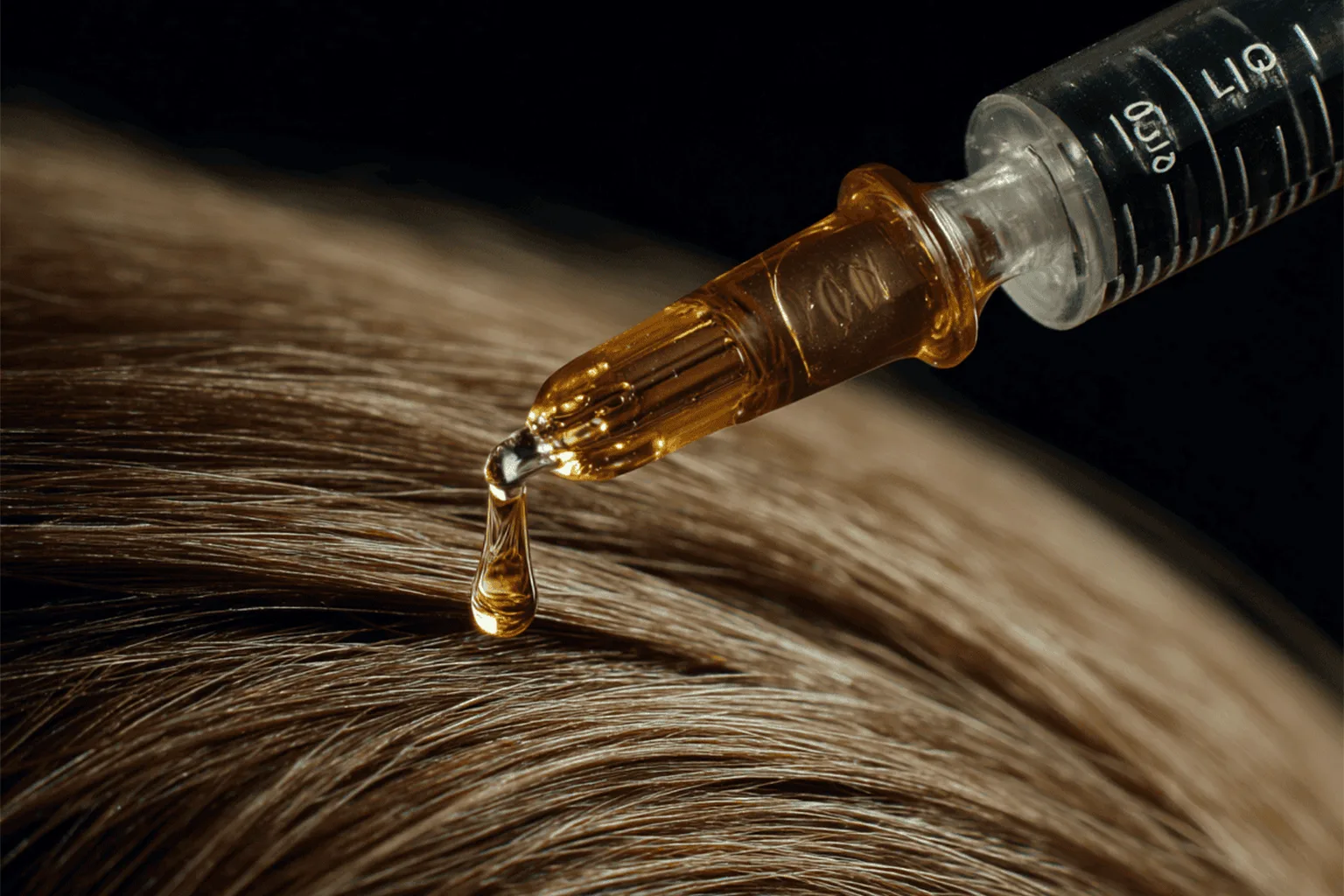
Hair mesotherapy is the delivery of the vitamins, minerals, amino acids and peptides that hair follicles need directly into the scalp with fine needles. The aim is to reach the target tissue without passing through the systemic circulation. I do not market the cocktail as a “personalised package”; I select the content according to the cause of the hair loss, and I do not start injections before finding the cause.
I am a specialist in anaesthesiology and reanimation; sterile technique and injection safety are core areas of my training. I perform hair treatments within this framework, carrying out every step of preparation and application myself. The types of hair loss and the steps of treatment are on the hair loss treatment page.
The cause first, then the content
I do not treat hair loss as a purely local problem. Before treatment I review the factors that may underlie it: iron stores (ferritin), thyroid function, vitamin B12 and D, and chronic stress load. I correct deficiencies with oral supplementation; mesotherapy is planned alongside that correction, not instead of it. The wider assessment framework is on the functional medicine page.
In hereditary hair loss, the treatments with the highest level of evidence are topical and oral drug treatments. I plan injection methods alongside these treatments, not instead of them; we assess the suitability and follow-up of drug treatment together at consultation.
The content is chosen according to the cause
I do not use a single fixed formula. At the level of ingredient classes, what I bring to the fore in each situation:
- Stress-related and seasonal shedding: B-complex vitamins, zinc and amino acids.
- Hereditary hair loss: peptide-based content and building blocks that support the environment around the follicle.
- After a hair transplant, and a compromised scalp: hyaluronic acid and components that support tissue repair.
Brand names, mixing ratios and quantities are not the subject of this page; which content is used is discussed at consultation. I do not claim that injections block a hormone.
Process and session plan
The scalp is cleansed with an antiseptic solution, and the mixture selected for that person is delivered into the scalp with fine needles. In suitable people, the mixture can also be applied by microneedling. The application takes 20–30 minutes.
I plan sessions two weeks apart. I do not fix the number of sessions in advance; I decide at consultation according to the type of hair loss and the response. Once the course is complete, I plan one maintenance session per month to preserve what has been achieved.
The effect is not immediate: a reduction in shedding is reported in the weeks following the first sessions, and thickening and density within months; it varies from person to person.
How does it differ from PRP?
With injections into the scalp, the decision depends on the content: when replacing missing nutrients and building blocks is the aim, mesotherapy with vitamins, minerals and peptides comes to the fore; when stimulating the follicle with its own growth signals is the aim, platelet-rich plasma does. The final choice is made at consultation.
Mesotherapy delivers externally prepared components to the tissue; PRP for hair is prepared from your own blood and contains growth factors. They are not rivals; they can be planned alternately when needed.
Skin mesotherapy and the general framework of the class are on the mesotherapy page.
Being honest about the level of evidence
The content of the mixtures used in hair mesotherapy is not standardised between clinics. Vitamin and mineral deficiencies can accompany hair loss; the most direct way to replace a deficiency is oral supplementation, and injection is a complementary route. For the vitamin and peptide mixtures described on this page, I do not rely on a controlled study; here I rely on my clinical practice. For this reason I do not describe mesotherapy as a treatment that “stops hair loss”, and I give no percentages without a source.
The procedure and pain management
Because I am an anaesthesiologist, I treat pain management as a separate part of the procedure.
Topical anaesthetic cream is not used routinely on the scalp; for very sensitive people it is applied before the treatment. What you feel is a brief sting.
Aftercare
First 24 hours
- Do not wash your hair (you can wash it the next day)
- No hot showers, sauna, hammam or steam
- Avoid heavy exercise
- No alcohol
- Do not touch the injection points; do not squeeze or massage the bumps
First 48 hours
- Avoid direct and prolonged sun exposure; wear a hat outdoors
Expected findings Mild redness and tenderness at the injection points are expected and settle the same day. Small bruises may last 1–2 days.
Additional advice
- Wait 2–3 days before hair dye and similar chemical treatments
- If redness increases, or warmth or fever develops, contact the clinic
- After a hair transplant, the timing is planned in line with the team that performed it
Safety and anatomy
Because allergic reactions can occur rarely, treatments are carried out under medical supervision.
Temporary redness, tenderness and small bruises may occur at the injection points; the expected durations are given in the aftercare section. The treatment is performed with sterile technique and is postponed if there is an active infection on the scalp.
Regulatory status: This product class consists of products assessed under CE and TİTCK frameworks for the relevant indications. Approval belongs to a product and to a specific indication, not to a technique or to a physician.
Who is not suitable
Treatment is not performed, or is postponed, in the following situations:
- Active infection or inflammation in the treatment area
- Autoimmune disease in an active phase
- Pregnancy and breastfeeding
- Known hypersensitivity to the product components
- Uncontrolled chronic illness
- Untreated bleeding disorder or unregulated anticoagulant use
Treatment is postponed if there is an open wound or an active flare of seborrhoeic dermatitis on the scalp, and in the early period after a hair transplant; injections are not given in alopecia areata during an active phase.
Without being a medical contraindication, I also consider expectation and treatment to be mismatched in these situations:
- People expecting hair to grow in an area where the follicle has been lost completely and the skin is smooth — a hair transplant is considered in that situation
- People expecting a marked change from a single session or within a short time
- People who cannot keep to a regular schedule of sessions — single-session methods are discussed in that situation
Suitability is determined by consultation in every case.
Pricing
Under the applicable regulations, price information cannot be published on our website. The cost of a treatment depends on the product used, the technique chosen and the extent of the treatment. You can call the clinic for detailed information.
Frequently asked questions
Is the same content used for everyone in hair mesotherapy?
No. The cause of hair loss varies from person to person; I select different content for stress-related and seasonal shedding, for hereditary hair loss, and for the period after a hair transplant. I make the choice at consultation.
Will hair loss return once the mesotherapy course ends?
Hereditary hair loss is a chronic process; when treatment ends, it continues from where it left off. This is why I plan one maintenance session per month once the course is complete.
Can I dye my hair after hair mesotherapy?
I recommend waiting 2–3 days after a session. Do not wash your hair on the day of the procedure; you can wash it the next day.
Planning your visit
My clinic is in Nişantaşı, Şişli, on the European side of Istanbul, approximately 45 minutes from Istanbul Airport.
For hair mesotherapy I suggest planning a stay of two to three days: arrival, consultation and treatment, and departure. Because this treatment is planned as a series, it requires more than one visit. The first session takes place in Istanbul, and we plan the schedule of the following sessions together according to your travel arrangements, with remote follow-up in between. Flying is generally appropriate 24 hours after an injectable treatment.
Consultations are conducted in English. Follow-up after you return home is arranged remotely, and I remain reachable for any questions during the period in which the result develops.
Dr. Ömer Fatih Şahin — Specialist in Anaesthesiology and Reanimation Diploma Registration No: 113606
Published: 22 February 2026 · Last updated: 2026-09-21 This content has been medically reviewed by Dr. Ömer Fatih Şahin.