
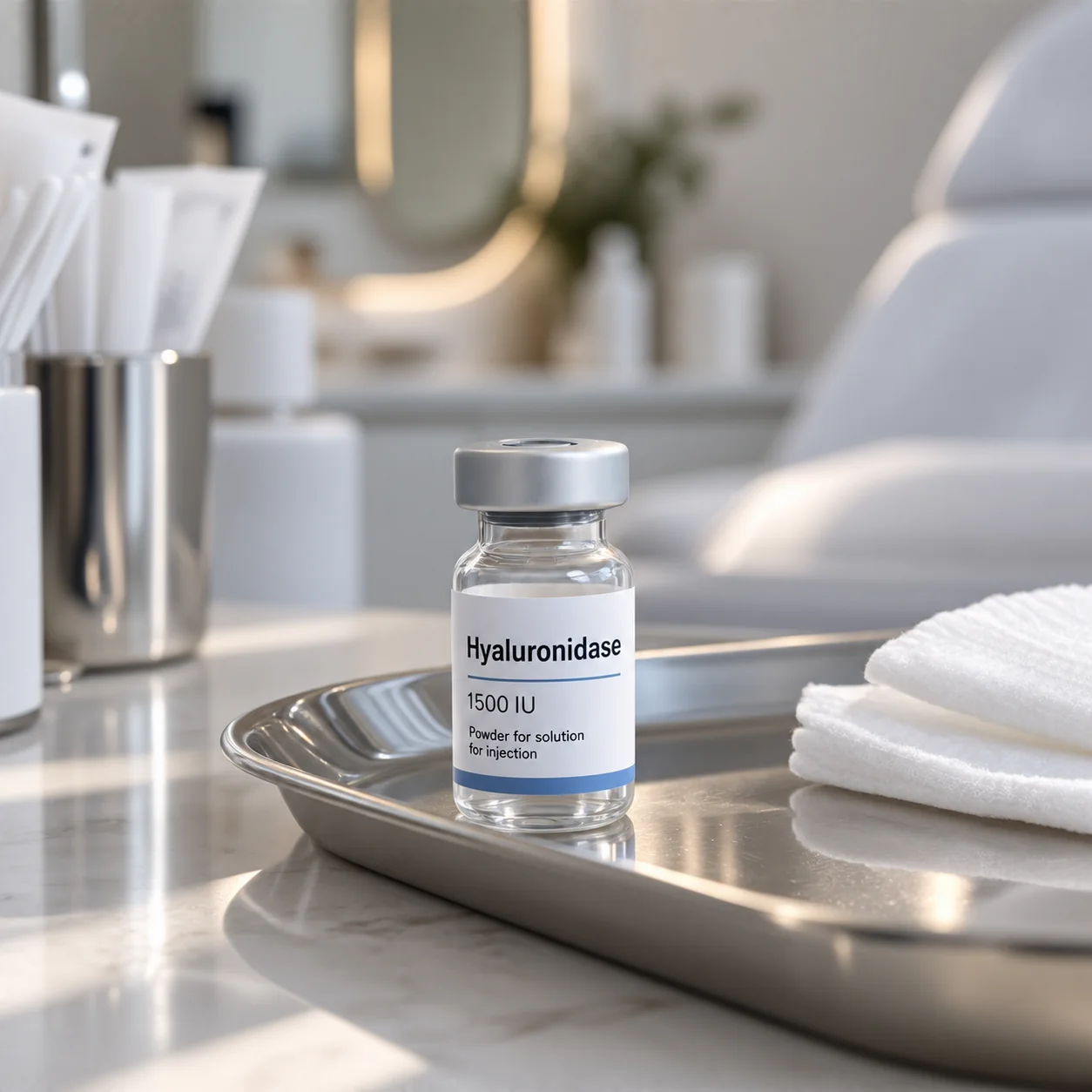
Filler dissolving is the process of breaking down a hyaluronic acid filler using an enzyme called hyaluronidase. Hyaluronidase breaks the bonds in hyaluronic acid, allowing the product in the treated area to be absorbed by the tissue more quickly.
I have written this as a separate page for a reason: do not have filler from a doctor who will not explain the way back. Reversibility is the most important safety property of hyaluronic acid, and understanding how it works is one of the questions to ask before treatment, not after. I describe the treatments themselves on the dermal fillers page.
The licensed indication for hyaluronidase is not the dissolving of filler; this use is considered off-label worldwide and rests on expert consensus 23. I carry out the treatment with that framing understood, under medical supervision, and in staged doses where appropriate.
When it comes up
- Excess volume. More product has been placed than the area can carry.
- Wrong plane or position. The product is not where it should be; a bluish cast under the eye, the Tyndall effect, is one example.
- Asymmetry. A difference between the two sides that needs correcting.
- Irregularity or nodule. A palpable or visible irregularity has remained.
- A result that does not match the expectation. The result is technically correct but not what you wanted.
People who are not my own patients also come to this page. If you are unhappy with treatment you had elsewhere, you are welcome to come for an assessment.
I will usually ask you to wait
This is the advice I give most often. The appearance in the first two to three weeks after treatment is not the result — swelling settles, the product integrates, and the appearance changes noticeably. This is particularly marked after lip filler.
Unless there is an urgent situation, I make the decision to dissolve no earlier than after the third week — that is, once the result has fully settled. A significant proportion of patients who wait find they do not need it.
Permanent fillers cannot be dissolved
This distinction matters: hyaluronidase only works on hyaluronic acid based products. Calcium hydroxyapatite (CaHA), poly-L-lactic acid (PLLA) and permanent products are not broken down by this enzyme.
This is part of why I use hyaluronic acid in my filler treatments.
How the treatment works
- Assessment. We discuss which product was used, when, and where. We can still assess it if you do not know, but knowing makes it easier.
- Application. The enzyme is placed into the area to be dissolved, in the plane where the product sits. It takes a few minutes.
- Result. Change generally begins within the first 24 to 48 hours; the final result becomes clear over a few days.
A single session may not achieve the intended result. Working in stages, according to the density and quantity of the product, is safer in terms of not overshooting 1. Where needed, we repeat the session.
Safety
The main consideration in hyaluronidase treatment is the possibility of an allergic reaction, which is why I carry it out under medical supervision and review your allergy history beforehand.
The enzyme acts only in the treated area, though it does affect some of the natural hyaluronic acid there. This is temporary; the tissue regenerates its own hyaluronic acid.
Short-lived mild redness, tenderness or a small bruise may appear at the injection points; these resolve on their own within a few days. Because an allergic reaction can occur rarely, treatments are carried out under medical supervision.
What we review together at your consultation
- Pregnancy and breastfeeding
- Active skin infection in the treatment area
- Known allergy to hyaluronidase or to bee stings
- Any previous reaction to hyaluronidase treatment
- Your current medication and general health
If one of these applies to you, we plan a more suitable alternative rather than the treatment.
Planning your visit
The clinic is in Nişantaşı, Şişli, Istanbul, about 45 minutes from Istanbul Airport. A stay of 2–3 days covers arrival, consultation and treatment, and departure. Injectable fillers need no recovery period; mild swelling may last two to three days, so if you have an event we plan the appointment around it. I do not commit to a plan over messages: we speak before you travel so you know what is realistic, and we confirm it in person on the day. Flying is usually fine 24 hours after an injectable treatment. Remote follow-up and contact are provided, and consultations are held in English.
Pricing
Under the applicable regulations, price information cannot be published on our website. The cost of a treatment depends on the product used, the technique chosen and the extent of the treatment. You can call the clinic for detailed information.
Frequently asked questions
How quickly does it work?
Change generally begins within the first 24 to 48 hours and the result becomes clear over a few days. A second session may be needed depending on the density of the product.
Will it dissolve my own tissue?
The enzyme also affects some of the natural hyaluronic acid in the area. This is temporary; the tissue regenerates its own hyaluronic acid. Lasting tissue loss is not expected.
Can I have filler again afterwards?
Yes. I would ask you to allow time for the tissue to recover; how long depends on the quantity dissolved and the area. When we plan again, discussing why the previous result was not what you wanted matters — it is how we avoid arriving at the same place twice.
I have permanent filler. Can it be dissolved?
No. Hyaluronidase is effective only on hyaluronic acid based products. Permanent products, and biostimulators such as CaHA and PLLA, are not broken down by this enzyme; the approach in that case is different and we assess it at consultation.
References
- Rao V, Chi S, Woodward J. Reversing facial fillers: interactions between hyaluronidase and commercially available HA-based fillers.
- Kroumpouzos G, Treacy P. Hyaluronidase for Dermal Filler Complications: Review of Applications and Dosage Recommendations. JMIR Dermatol. 2024;7:e50403.
- Borzabadi-Farahani A, et al. A Scoping Review of Hyaluronidase Use in Managing the Complications of Aesthetic Interventions.
Medically reviewed by Uzm. Dr. Ömer Fatih Şahin, Specialist in Anaesthesiology and Reanimation Published: 2026-09-21 · Last updated: 2026-09-28