
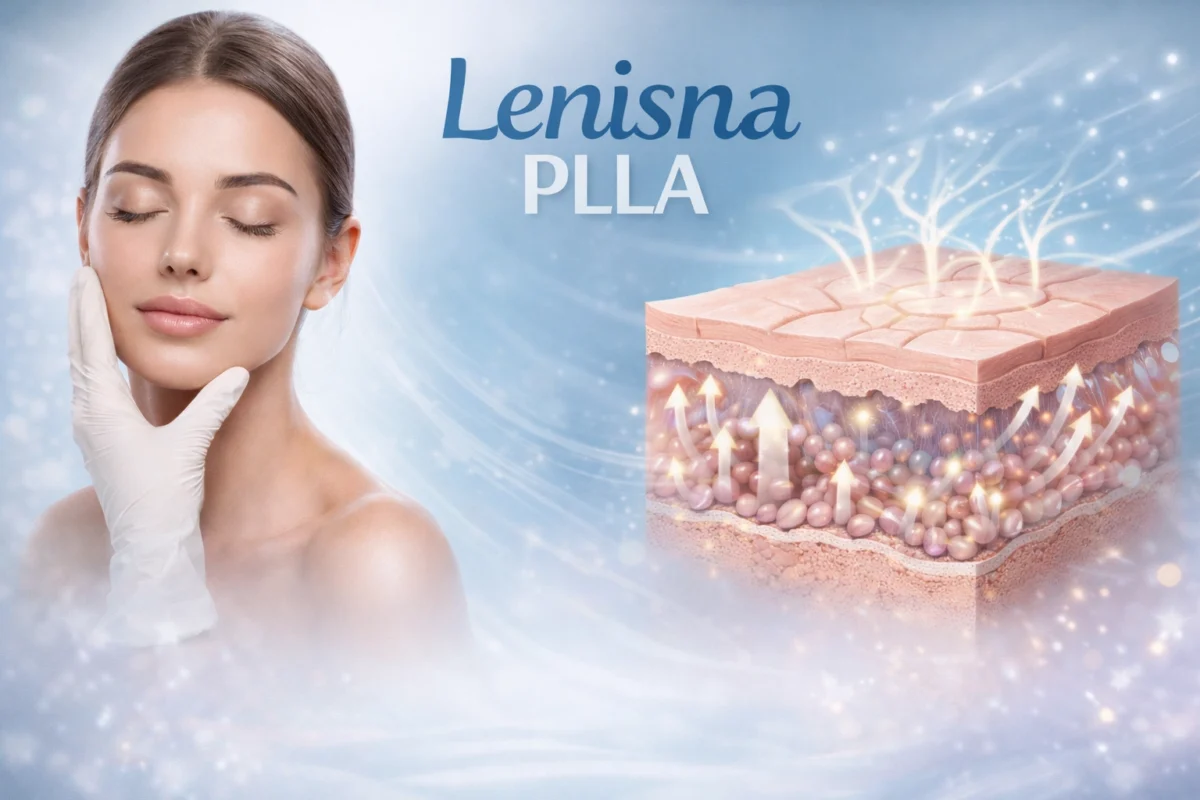
In the evolving world of aesthetics, the pursuit of “natural volume” and “biological lifting” has standardized the use of advanced polylactic acid technologies. As a premier representative of this category, Lenisna is a high-performance hybrid restructurer that utilizes the synergy of high-density PDLLA (Poly-D,L-Lactic Acid) and Hyaluronic Acid (HA).
Lenisna provides a specialized protocol designed to tighten facial contours while repairing deep tissue loss by stimulating the body’s endogenous collagen production.
Structural Bio-Matrix: Functional Dermal Engineering
Based on technical data regarding Lenisna, its regenerative pathway within the dermal layers can be defined as follows:
Hybrid Formulation: Each vial contains a potent concentration of 170 mg PDLLA and 30 mg Hyaluronic Acid.
Dual-Phase Induction: Upon application, the HA component provides immediate hydration and subtle shaping; meanwhile, the primary PDLLA micro-particles initiate a neocollagenesis (new collagen synthesis) process that unfolds over several months.
Architectural Molecular Structure: The macro-particles, sized between 40-80 microns, create a structural scaffold within the deep dermis and subcutaneous tissue, reinforcing the skin’s internal framework.
Targeted Applications: Ideal Treatment Zones
Lenisna is considered an “architectural” support product, making it the preferred choice for areas requiring deeper structural volume:
V-Line and Jawline: Defining the jawline and lifting sagging tissues for a sharper contour.
Temples and Mid-Face: Restoring volume to hollow temples and sunken cheeks with a natural appearance.
Deep Folds: Biologically softening pronounced nasolabial folds (smile lines).
Body Contouring: Providing collagen support for areas experiencing elasticity loss, such as the abdomen, inner arms, and above the knees.
Market Analysis: Polylactic Acid Brand Comparison
There are various technological approaches to polylactic acid treatments globally. The differences between the market’s leading players are summarized below:
Brand and Technology Matrix
Feature | Sculptra | Lanluma X | Lenisna |
Molecule Type | Pure PLLA | Pure PLLA | PDLLA + HA (Hybrid) |
Clinical Approval | FDA Approved | CE Certified | CE Certified |
Massage Duration | 5 Days (5-5-5 Rule) | 14 Days (10 min, 2x daily) | Not Required |
Application Area | Face & Body | Face & Body | Face & Body |
Primary Effect | Natural Volume & Repair | Deep Repair & High Body Volume | Lifting & Biological Restoration |